
The mammalian target of rapamycin (mTOR) signaling cascade receives and consolidates signals originating from both inside and outside cells, and exerts critical regulatory effects on a wide array of cellular activities, including metabolic balance, cell expansion, division, and cell survival.
This signaling axis governs numerous essential biological events: protein synthesis and degradation, lipid and carbohydrate metabolic processes, cell growth, proliferation, survival, autophagic turnover, cytoskeleton remodeling, and more. Abnormal activation or suppression of mTOR signaling contributes to the pathological mechanisms behind multiple illnesses, such as malignant tumors, cardiovascular disorders, and type 2 diabetes.
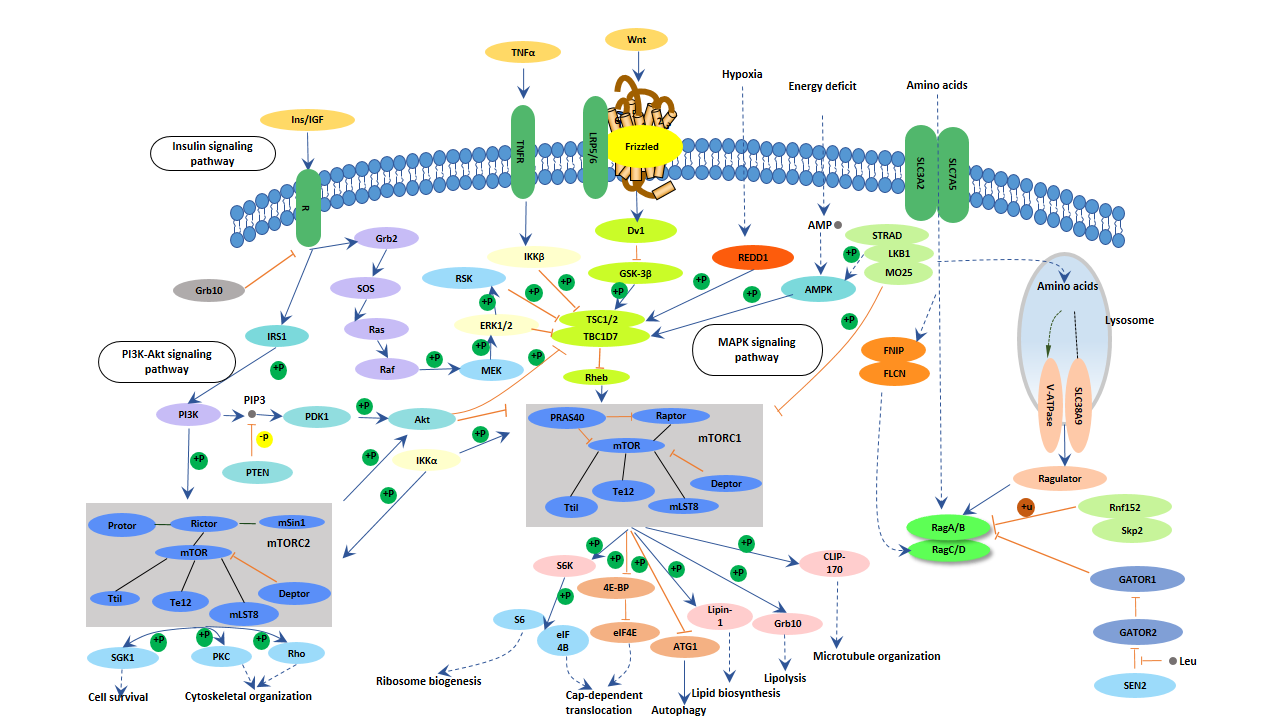
mTOR itself belongs to an evolutionarily conserved atypical serine/threonine protein kinase. It assembles with distinct accessory proteins to form two separate multi-subunit assemblies, namely mTOR complex 1 (mTORC1) and mTOR complex 2 (mTORC2). These two complexes take charge of disparate cellular regulatory events.
As the shared catalytic core of both assemblies, mTOR acts as a serine/threonine kinase that modulates cell growth, migratory capacity, viability, protein biosynthesis, autophagy, and gene transcription.
mLST8 (also termed GβL) and DEPTOR exist as shared subunits within both complexes. Beyond these two common components, mTORC1 further incorporates Raptor and PRAS40. Raptor recognizes the TOS (target of rapamycin signaling) motifs on mTOR downstream substrates in a rapamycin-responsive fashion, which drives the activation of mTORC1.
By contrast, mTORC2 uniquely binds Rictor, mSIN1, and Protor1/2; its biological functionality relies entirely on Rictor and mSIN1. Multiple upstream stimuli can trigger mTOR pathway activation, including growth factors (insulin, IGF1 for instance), cellular stress cues, intracellular energy and metabolic status (oxygen levels, ATP/ADP ratio), amino acid nutrition (leucine, arginine), as well as neuromodulatory molecules such as neuropeptides and glutamate.
The mTOR cascade ranks among the most extensively researched signal transduction routes, and it participates in tissue injury as well as a broad spectrum of central nervous system disorders. Dysregulated mTOR activity is observed in many neurodegenerative pathologies, such as Alzheimer’s disease, Parkinson’s disease, ischemic cerebral stroke, and Huntington’s disease. Suppressing mTOR kinase activity can mitigate the neuronal damage linked to these degenerative illnesses.