
Nuclear factor-kappa B (NF-κB) refers to a collective group of transcription factor proteins that exert biological effects in dimeric forms, controlling the expression of target genes associated with immune defense, inflammatory reactions and cellular survival status.
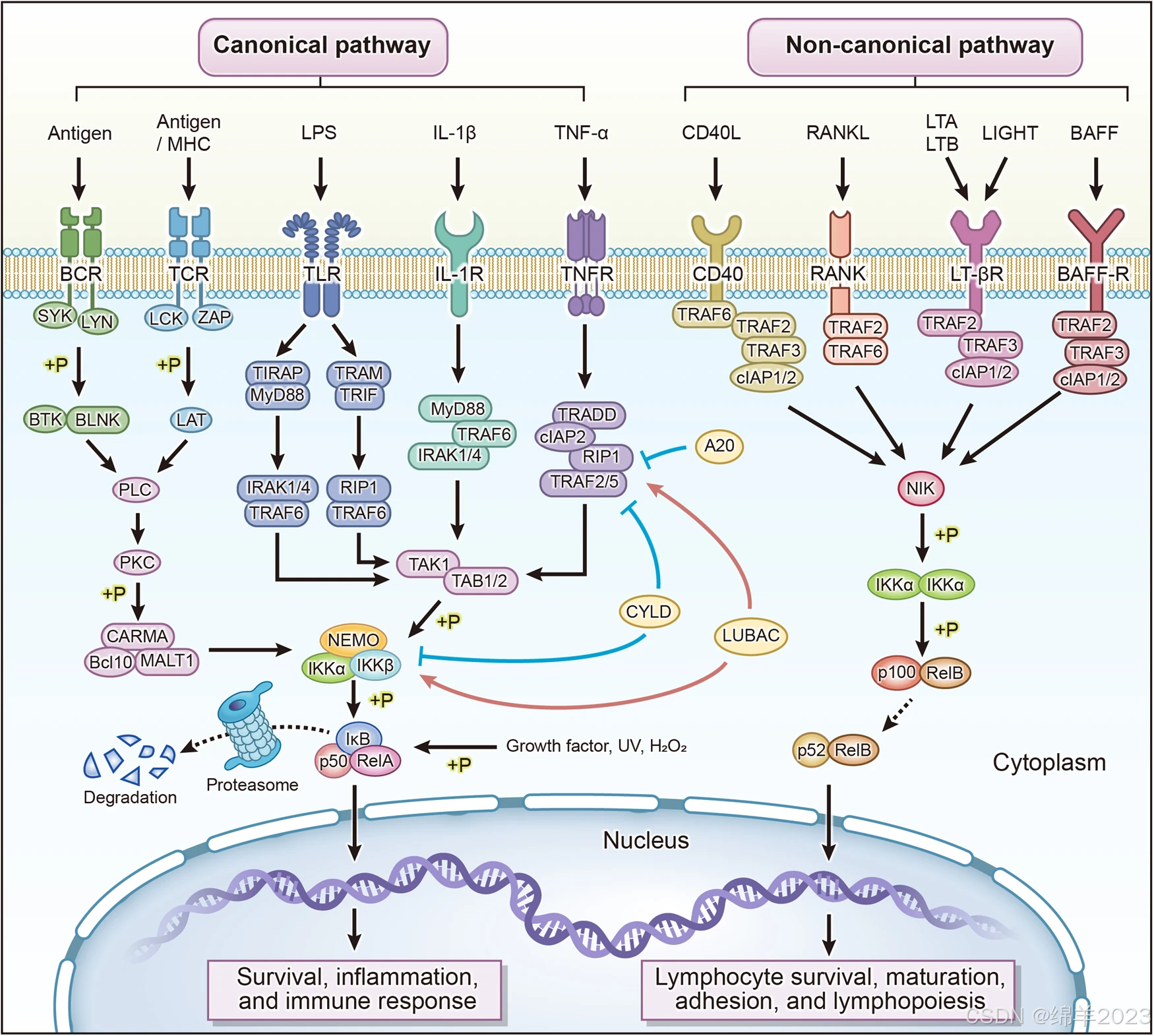
Multiple signal transduction routes can induce the activation of NF-κB dimers, which are divided into two core subtypes as follows.
This classical signaling branch gets stimulated by tumor necrosis factor α (TNF-α), interleukin-1 (IL-1), as well as bioactive substances released during bacterial and viral invasive infections. Its operation hinges on the IKK complex catalyzing phosphorylation on the Ser32 and Ser36 sites of IκBα, which subsequently triggers ubiquitination-mediated degradation of IκBα. After IκBα breakdown, the p50/p65 NF-κB dimer gains the ability to transfer into the cell nucleus and activate the transcription of downstream functional genes.
This atypical signaling mode does not depend on the IKK complex for its activation. Its triggering mechanism relies on phosphorylation modification at the Tyr42 residue of IκBα or serine sites located within the PEST structural domain of IκBα. This pathway is activated by particular receptor members of the TNFR superfamily, such as lymphotoxin-beta (LT-β) and BAFF. During signal transmission, NIK and IKKα jointly mediate phosphorylation and proteolytic processing of p100 to produce mature p52 subunits; this process enables p52/RelB heterodimers to shift into the nucleus and regulate gene transcription.
In general, the NF-κB signaling axis takes part in a wide range of physiological and pathological events, including pathogen clearance, inflammatory response, immune functional regulation, cell apoptosis control, tumor formation, cell cycle modulation and cell differentiation. All these biological outcomes are realized through the expression of target gene encoding products. Intracellular adaptor proteins recruit the IKK complex to trigger phosphorylation and degradation of IκB inhibitors, releasing NF-κB to translocate into the nucleus. Disturbed NF-κB signal balance is closely associated with chronic inflammatory illnesses, autoimmune disorders and multiple malignant tumors.
After NF-κB dimers enter the nuclear compartment, they attach to the conserved NF-κB binding sequence 5'-GGGRNNYYCC-3' on the promoter or enhancer segments of target genes, initiating the transcription of numerous functional effector molecules.
Induced gene products are categorized into six functional groups:
- Cytokines: TNF-α, IFN-β, IL-1β, IL-2, IL-3, IL-6 and other related mediators;
- Chemokines: IL-8, RANTES, MCP-1;
- Cell adhesion proteins: E-selectin, ICAM-1, VCAM-1;
- Acute phase response proteins and complement system components;
- Growth regulatory factors: GM-CSF, G-CSF, M-CSF;
- Various transcription factors and other functional proteins.