
The HER family also comprises HER2, HER3 and HER4. All members jointly regulate diverse physiological activities inside cells.
Located on cell membrane surface, EGFR can be activated by ligands including EGF and trigger dimerization. This reaction further stimulates intracellular tyrosine kinase activity and initiates downstream signaling cascades to complete transmembrane signal transmission.
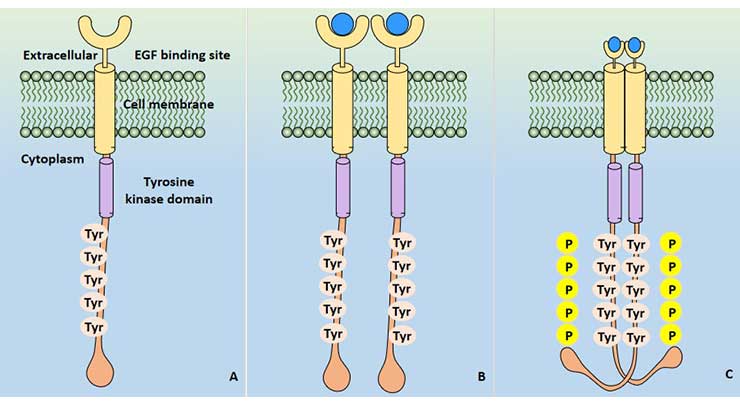
Six endogenous ligands capable of binding with EGFR have been identified, namely epidermal growth factor, transforming growth factor alpha, amphiregulin, betacellulin, heparin-binding EGF and epiregulin. Among them, EGF and TGF-α function as the predominant ligands of EGFR.
EGFR participates in cellular signal transmission, proliferation and differentiation regulation. Aberrant overexpression and dysfunction of EGFR are commonly observed in malignant tumors, making it a core research target for tumor diagnosis and targeted therapy.
Sequence alignment reveals around 80% structural homology between human and murine EGFR, which demonstrates high evolutionary conservation of this protein.
Structurally, EGFR is divided into three functional domains: extracellular segment, transmembrane segment and intracellular segment.
The N-terminal extracellular domain contains 621 amino acids and acts as the major ligand binding region, which can be classified into four subdomains.
The transmembrane segment is a helical hydrophobic structure composed of 23 amino acids. It connects with the extracellular domain via proline residues and anchors the receptor onto cell membrane.
The intracellular domain has 542 amino acids, consisting of juxtamembrane region, tyrosine kinase region and C-terminal region.
EGFR dimerization activates intrinsic kinase activity and induces tyrosine phosphorylation. Three major downstream pathways are subsequently activated, including Ras/Raf/MEK/ERK/MAPK pathway, PI3K/Akt pathway and JAK/STAT pathway. These coordinated signaling pathways modulate cell differentiation, survival, migration, invasion, adhesion and tissue repair.
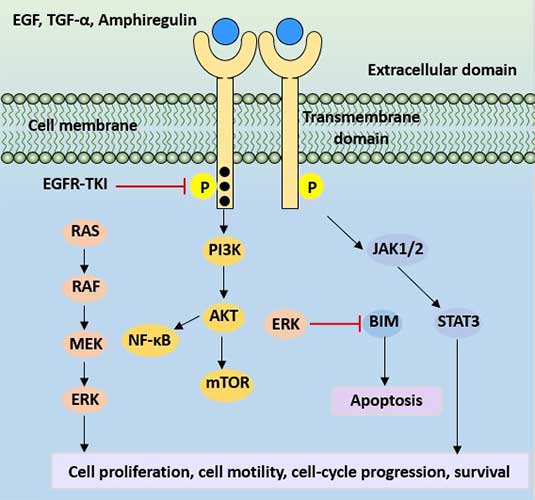
Widely expressed on various somatic cells, EGFR regulates tumor cell proliferation, angiogenesis, invasion, metastasis and apoptosis. Abnormal upregulation of EGFR contributes greatly to tumor progression, and irregular EGFR expression can be detected in numerous malignant tissues and tumor cell lines.
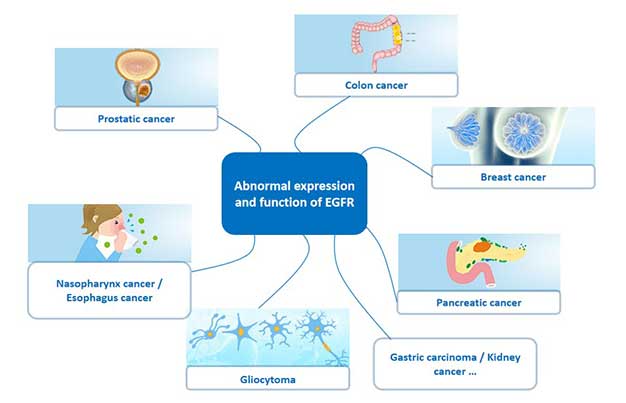
Unusual EGFR expression frequently occurs in patients suffering from lung cancer, breast cancer, gastric cancer, colorectal cancer, pancreatic cancer and prostate cancer. The abnormal expression proportion in different tumor types is listed below:
| Cancer Type | Abnormal Expression Rate |
|---|---|
| Lung cancer | 40-80% |
| Breast cancer | 14-91% |
| Gastric cancer | 33-74% |
| Colorectal cancer | 25-77% |
| Pancreatic cancer | 40-80% |
| Prostate cancer | 40-80% |
| Renal cancer | 50-90% |
| Ovarian cancer | 35-70% |
| Head and neck tumor | 36-100% |
This therapeutic strategy applies monoclonal antibodies, tyrosine kinase inhibitors, antisense nucleotides and other bioactive substances to block disordered signal transmission and restrain tumor growth.
Excessive expression and gene mutation of EGFR are closely linked with tumor occurrence, development and clinical prognosis, laying solid theoretical and experimental foundations for targeted drug development. Current mainstream clinical treatments fall into two categories: monoclonal antibody therapy and tyrosine kinase inhibitor therapy.
In vitro experiments verify that these antibodies reduce angiogenic factor secretion and inhibit endothelial cell migration. In vivo administration downregulates angiogenic related factors, restrains neovascularization and lowers tumor metastasis risk.
Four types of EGFR targeted monoclonal antibodies have been approved globally, including cetuximab, panitumumab, necitumumab and nimotuzumab.
Cetuximab possesses outstanding specific binding capacity with higher affinity than natural ligands. It inhibits receptor activation and promotes EGFR endocytosis and degradation, applicable to metastatic colorectal cancer, head and neck cancer and non-small cell lung cancer.
Necitumumab binds selectively to EGFR and blocks ligand binding. With precise targeting property, it minimizes damage to normal cells and is generally combined with chemotherapeutics for certain subtypes of non-small cell lung cancer.
Panitumumab is a fully humanized IgG2 antibody with high EGFR affinity, which effectively reduces immune rejection and improves medication safety.
Nimotuzumab is an independently developed domestic anti-tumor monoclonal antibody, mainly applied combined with radiotherapy to treat advanced nasopharyngeal carcinoma with positive EGFR expression.
Antibody drugs remain a popular research focus in biopharmaceutical industry, accounting for 60% of all EGFR targeted research projects. These antibodies arrest cell cycle progression, accelerate cancer cell death, inhibit angiogenesis and metastasis, and enhance sensitivity to radiotherapy and chemotherapy.
First-generation inhibitors simulate the cyclic structure of ATP, occupy ATP binding sites and prevent receptor autophosphorylation. They interrupt downstream signal transmission, curb tumor growth and induce cell apoptosis.
| Target | Drug Name | Approval Time | Indications | Manufacturer |
|---|---|---|---|---|
| EGFR | Gefitinib | 2003 | Non-small cell lung cancer | AstraZeneca |
| EGFR | Erlotinib | 2004 | Non-small cell lung cancer, Pancreatic cancer | Roche |
| EGFR/HER2 | Lapatinib | 2007 | HER2-overexpressed breast cancer | GlaxoSmithKline |
| Drug Name | Research Progress | Manufacturer |
|---|---|---|
| Afatinib | Approved for NSCLC in 2013 | Boehringer Ingelheim |
| PF-00299804 | Phase III clinical trial for NSCLC | Pfizer |
| HKI-272 | Phase III clinical trial for breast cancer | Wyeth |
Along with expanded clinical application, triple mutation L858R/T790M/C797S has been detected in patients, which leads to therapeutic failure of mainstream third-generation drugs. Fourth-generation inhibitors targeting this rare mutation are now in preclinical research phase.
Nevertheless, monoclonal antibodies have inherent limitations. They cannot be used alone for tumor treatment and usually require combination with radiotherapy or chemotherapy, with limited applicable cancer types.
Continuous research on small-molecule kinase inhibitors yields multiple candidate drugs with promising bioactivity, providing references for developing potent and highly selective targeted medicines. Drug resistance triggered by gene mutation has not been fully resolved, leaving vast room for mutation-specific inhibitor development.
EGFR targeted anti-tumor research has achieved remarkable advances and stays as one of the most dynamic research fields, while multiple technical defects still need further optimization.