
Proteins are fundamental biomolecules that serve as the core carriers of life activities and primary executors of diverse biological functions in living organisms. They participate in nearly all critical physiological processes, including cytoskeleton formation and maintenance, enzymatic biochemical catalysis, intracellular signal transduction, transmembrane molecular transport, as well as the regulation and activation of human immune responses.
The biological function of any protein is tightly determined by its unique spatial structure at multiple levels. In consequence, clarifying the complete structural features and intermolecular interaction patterns of proteins lays a solid foundation for exploring the operating mechanisms of organisms. As an indispensable analytical workflow in protein research, protein characterization acts as a core tool to correlate protein structure with corresponding biological functions.
Protein characterization refers to a systematic series of qualitative and quantitative analytical experiments designed to identify, quantify and comprehensively describe the physicochemical properties, multi-level spatial structures and biological activities of target proteins. A complete protein characterization system covers multiple key detection indicators, including protein sample purity, accurate molecular weight, complete primary and advanced structure, diverse post-translational modifications (PTMs), surface charge properties, as well as dynamic interaction behaviors between proteins and other biomolecules.
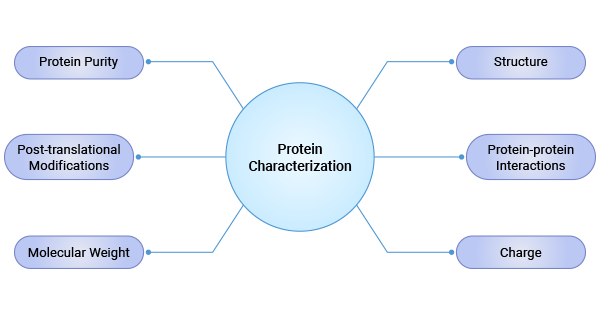
Protein characterization occupies a core position in modern biopharmaceutical research and life science exploration. It provides accurate and reliable structural and functional data of target proteins, which supports in-depth exploration of disease pathogenesis, rational design of novel drug candidates, and strict quality inspection to guarantee the safety, stability and therapeutic efficacy of protein-based biologic drugs.
Detailed research values of protein characterization are summarized as follows:
- Revealing intrinsic mechanisms of physiological and pathological processes: Systematic structural and interaction analysis of proteins helps researchers decode the underlying molecular mechanisms of core life activities, such as intracellular signaling cascades, gene transcription and expression regulation, as well as the occurrence and progression logic of various human diseases.
- Accelerating the whole process of drug discovery and development: Protein targets dominate the majority of clinical drug research projects. Clarifying the binding mode and affinity between candidate drugs and target proteins assists researchers in optimizing drug molecular structures, improving drug targeting specificity, enhancing therapeutic effects, and effectively reducing non-specific binding and corresponding clinical side effects.
- Guiding innovative research in biotechnology and bioengineering: Mastering the structure-function correlation of proteins enables rational design, directional modification and molecular engineering of recombinant proteins. This customized protein optimization strategy can produce engineered proteins that meet customized experimental, industrial and clinical application requirements.
Diversified analytical platforms and testing technologies are adopted for protein characterization to comprehensively evaluate protein composition, hierarchical folding structure, biological activity and molecular interaction characteristics. The core principles, applicable scenarios, strengths and limitations of mainstream detection methods are listed in the table below:
| Protein Characterization Methods | Mechanism | Application | Advantages | Disadvantages |
|---|---|---|---|---|
| Mass Spectrometry (MS) | Proteins are ionized under specific experimental conditions; charged protein ions are separated and detected according to mass-to-charge ratios. The acquired mass spectrogram is further matched with standard protein databases to complete molecular identification and modification analysis. | Full-length protein sequencing, qualitative and quantitative detection of various post-translational modifications (PTMs) | Ultra-high detection sensitivity and specificity, excellent resolution; compatible with simultaneous analysis of complex mixed protein samples without tedious separation in advance | Mandatory pre-treatment of raw protein samples; dependent on high-end professional testing equipment and experienced operational technicians |
| SDS-PAGE | Under a stable external electric field, proteins are separated inside polyacrylamide gel matrices based on differences in molecular size and surface charge after denaturation treatment. | Preliminary separation and molecular weight estimation of proteins based on molecular dimension and charge differences | Simple operation flow, low experimental cost, highly mature and widely adopted conventional laboratory technique | Poor separation resolution for ultra-large molecular weight proteins; unable to reflect advanced folding structure information of target proteins |
| Western blot (WB) | Highly specific antigen-antibody binding reaction is applied to realize targeted recognition, qualitative identification and relative quantitative detection of specific target proteins. | Specific isolation, identification and relative quantification of single target protein from complex biological samples | Excellent detection specificity and sensitivity for targeted protein verification | Complicated experimental steps, long overall testing cycle and heavy manual operation workload |
| Circular Dichroism (CD) Spectroscopy | Detect the differential light absorption capacity of chiral protein molecules towards left-handed and right-handed circularly polarized light, so as to analyze the secondary structure composition and structural folding stability of proteins. | UV CD: quantitative analysis of protein secondary structure; IR CD: structural research of small biomolecules, proteins and nucleic acid DNA; UV/Vis CD: exploration of charge transfer reaction characteristics inside metal-protein complex systems | Intuitive acquisition of protein secondary structure data; fast detection speed suitable for batch rapid structural screening | Limited analytical resolution for proteins with complex multi-domain advanced structures |
| X-ray Crystallography | High-precision diffraction patterns generated by ordered protein crystals under X-ray irradiation are analyzed to reconstruct the complete three-dimensional atomic spatial structure of proteins. | Resolving high-precision full 3D atomic structure of target proteins | Atomic-level ultra-high resolution and detection accuracy; provide complete and detailed static structural data of proteins | Difficult and time-consuming protein crystal preparation is required; structural data analysis consumes massive time and experimental resources |
| Nuclear Magnetic Resonance (NMR) Spectroscopy | Collect characteristic nuclear magnetic resonance signals of hydrogen, carbon and other atoms in protein molecules to analyze dynamic and static protein structures under native solution environments. | In-situ structural analysis of proteins in physiological liquid environment | Non-destructive detection method; support atomic-level static structure and real-time dynamic conformational change analysis | Not applicable for ultra-large protein macromolecules; require high-concentration protein samples and isotopic labeling pretreatment; long data acquisition period |
| Surface Plasmon Resonance (SPR) | Real-time monitoring of refractive index changes on metal chip surfaces caused by molecular binding between immobilized proteins and free biomolecules in flowing buffer solution. | Real-time dynamic detection of intermolecular binding kinetics and affinity parameters | Label-free real-time monitoring of protein interaction processes; high sensitivity for weak molecular binding events | High cost of professional instruments and consumable chips; only applicable to interactions involving ligands fixed on chip surfaces |
Mass spectrometry, X-ray crystallography, NMR spectroscopy and SPR technology are four mainstream core techniques for modern protein characterization, and each method possesses unique application advantages and inherent limitations. Researchers need to select matched detection strategies comprehensively based on actual sample characteristics, specific research objectives and laboratory hardware conditions.
In general, mass spectrometry is more suitable for qualitative and quantitative analysis of low-molecular-weight proteins. For high-molecular-weight proteins requiring detailed structural annotation, X-ray crystallography and NMR spectroscopy are preferred options to obtain high-precision spatial structure information. SPR technology stands out in monitoring dynamic molecular binding processes and constructing protein interaction networks. Therefore, comprehensive consideration of experimental demands is essential to select the most suitable characterization scheme for individual protein research projects.
With the rapid development of life sciences and analytical testing technology, protein characterization has become a universal supporting tool covering multiple research and industrial fields. Its key application directions are classified as follows:
In fundamental molecular biology and biochemistry experiments, protein characterization helps researchers clarify endogenous biological pathways. It also supports directional protein modification and molecular redesign in protein engineering research, providing reliable basic experimental data for exploring universal life operation rules.
By characterizing abnormally expressed proteins closely related to human diseases, researchers can clarify their pathogenic molecular mechanisms. Besides, this technology assists in screening novel disease-specific biomarkers, developing individualized targeted treatment regimens and identifying reliable protein targets for new antineoplastic and antiviral drugs.
Protein-based biotherapeutics including monoclonal antibodies, recombinant cytokines and vaccine antigens require strict full-process protein characterization. This technology supports targeted drug molecular design, batch-to-batch consistency quality inspection of finished biological drugs, purity control of finished products, and mechanism analysis of in-vivo binding between drugs and target proteins.
In the food manufacturing and safety supervision industry, protein characterization serves nutritional component detection, food safety risk assessment and finished product quality control. It can accurately detect total protein content in food raw materials and finished products, screen common food allergen proteins, and guide formula optimization to guarantee nutritional value, edible safety and functional performance of commercial food products.
The above diversified application scenarios fully prove that protein characterization is an indispensable analytical technology that promotes interdisciplinary progress across life science, pharmaceutical engineering and food safety industries.
Protein characterization is a systematic analytical technology that bridges protein structural features and biological functions. Through comprehensive qualitative and quantitative detection, researchers can obtain accurate data covering protein amino acid sequence, folding conformation, post-translational modification status and intermolecular interaction characteristics. These analytical results further help annotate complex intracellular signaling pathways, decode molecular pathogenic mechanisms, and accelerate the whole research and development process of innovative biological drugs. In short, standardized and complete protein characterization is an essential guarantee for reliable and repeatable protein-related research in both academic and industrial fields.