
Blog

Antibody Cross-reactivity: A Double-edged Sword in Immunology
Back in 1796, British clinician Edward Jenner accomplished a landmark medical achievement: he administered cowpox inoculation to eight-year-old James Phipps for prophylaxis against lethal smallpox. This pioneering inaugural vaccine took effect not owing to mysterious factors, but through an immunological principle that remained obscure for a long time, namely antibody cross-reactivity. Acting as a double-edged biological factor, this property has continuously influenced the evolution of medical development ever since, and this paper systematically sorts out its full profile from multiple dimensions.
This manuscript centers on the definition, generating mechanisms, biological functions, practical usage scenarios and optimization approaches of antibody cross-reactivity.
1
Core Definition of Cross-reactivity
Before introducing cross-reactivity, two fundamental concepts, epitope and paratope, need preliminary explanation.
1.1 Epitope and Paratope
An epitope, also known as antigenic determinant, is a short amino acid fragment with merely 5 to 6 residues situated on antigen surfaces and can be selectively recognized by matching antibodies. Certain antigens carry only one epitope site, whereas numerous other antigens are equipped with two or more disparate epitope structures.

The paratope stands for the 3D conformation formed by the terminal segment from variable domains (light chain plus heavy chain) of antibodies via complementary folding, consisting of 5–10 amino acid residues and functioning to specifically identify and conjugate with antigen epitopes. Each terminal end of two arms on Y-type antibodies features identical paratope structures. Accordingly, the combination between antibody and antigen essentially originates from the binding interaction between paratope and epitope.
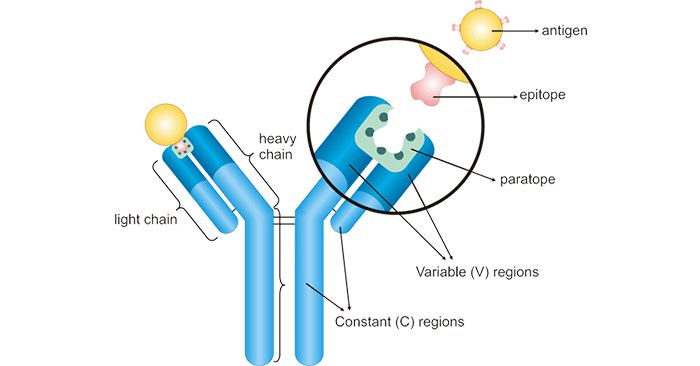
抗体-抗原结合结构图

Figure 1: Schematic drawing of antigen-antibody binding structure
1.2 Definition of Cross-reaction

When an antibody combines with irrelevant antigens apart from the initial immunogen triggering its synthesis, such immunological behavior is classified as cross-reaction. Shared epitope sequences across multivalent antigens or analogous spatial conformation of epitopes from different antigens constitute the primary triggers of cross-reaction.
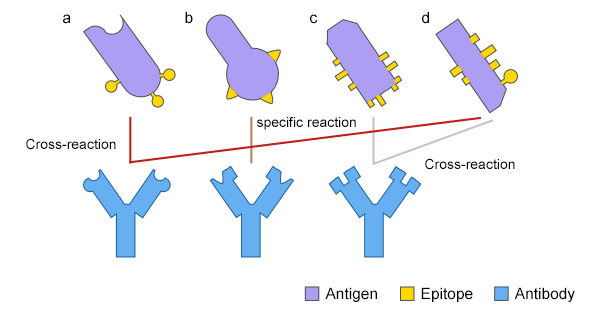
抗体在两种不同抗原间的交叉反应

Figure 2: Schematic illustration for antibody cross-binding toward two distinct antigens
1.3 Definition of Cross-reactivity
From the immunological perspective, cross-reactivity is described as the inherent capability of a single antibody molecule to bind identical or structurally analogous epitope domains distributed on diverse antigen molecules.
2
Correlation & Distinction Between Cross-reactivity and Immunological Specificity
Immunological specificity means antibody paratopes can only target one exclusive epitope derived from its corresponding antigen. It is worth noting that this unique epitope sequence may exist on more than one type of antigen molecule. The compositional types, amino acid arrangement sequence and stereoscopic structure of antigen epitopes jointly determine antibody specificity. Benefiting from specificity, target antigens can be accurately quantified in detection systems to avoid false results caused by interfering analog antigens; it is the core characteristic of immune response and lays the theoretical foundation for clinical immune prevention as well as diagnostic testing.
By contrast, cross-reactivity manifests when one antibody molecule links two or more antigens with high sequence homology or identical epitope segments. Within immunoassay platforms, polyclonal antibodies with proper cross-reactive features help elevate detection sensitivity and facilitate measurement of low-abundance target antigens.
Specificity reflects how precisely the immune system differentiates various antigens, while cross-reactivity mirrors the structural similarity degree among different antigens from immune recognition perspective. In most cases, elevated cross-reactivity will correspondingly weaken overall detection specificity.
3
Dual-sided Biological Impacts of Cross-reactivity
Antibody cross-reactivity possesses both protective physiological effects and adverse pathogenic effects. On the positive side, cross-reactive antibodies build cross-protective immunity against mutant pathogen strains or closely-related pathogenic variants under natural infection conditions; namely, cross-reactivity expands the defensive range of humoral immunity against heterogeneous pathogenic microorganisms. Existing research data verify that multiple pathogens including schistosome, influenza virus and Streptococcus pneumoniae exploit antibody cross-reactivity as an immune evasion mechanism to survive inside host bodies.
On the negative side, inappropriate cross-reactive antibody binding triggers harmful inflammatory cascades, which further induce or aggravate infectious complications, autoimmune disorders and allergic illnesses accompanied with host tissue damage. During serological pathogen identification, unexpected cross-reactivity disturbs differential diagnosis and leads to ambiguous identification outcomes.
Moreover, cross-binding interference disrupts the stability and repeatability of immunoassay readouts. For instance, in abused drug screening projects, antibodies may cross-react with chemicals sharing similar molecular frameworks with target drugs and consequently produce false-positive test outcomes.
4
Practical Applications of Antibody Cross-reactivity
Reasonable utilization of cross-reactivity expands the application scope of prepared antibodies. Antibodies generated against human-derived antigens often display favorable cross-binding activity toward homologous proteins from experimental animals such as mice, rats and rabbits; this interspecies cross-reaction enables researchers to employ identical antibody resources to detect conserved homologous proteins across multiple model species at ExKits.
Such interspecific cross-reactive characteristics also contribute to exploring specific immune pathological mechanisms, assisting diagnosis of certain infectious disorders and inducing immune responses against hard-to-purify target antigens. Meanwhile, cross-reactivity verification serves as an essential indicator to confirm the specificity performance of ExKits ELISA detection kits targeting designated protein markers.
In clinical laboratory testing, heterophile antibody detection relying on cross-reactive principle is widely adopted for rapid screening of Epstein-Barr virus (EBV) antibody, the causative pathogen of infectious mononucleosis. Besides, cross-reactivity assessment is a standard validation indicator during the performance verification of immuno-detection techniques including ELISA and radioimmunoassay (RIA).
5
Feasible Strategies to Reduce or Eliminate Undesired Cross-reactivity
Performing cross-reactivity verification against structurally close antigens is an indispensable item during antibody quality validation. Selecting matched antibody combinations turns into the most straightforward solution to cut down non-specific cross-binding in immunoassays: monoclonal antibodies are preferred as capture primary antibodies to secure high detection specificity, while polyclonal antibodies are commonly applied as conjugated detection antibodies to optimize testing sensitivity.
For clinical anti-allergy treatment, patients with confirmed drug allergy history must avoid medications possessing analogous chemical skeleton with sensitizing drugs. Macrolide preparations including erythromycin, medemycin, midecamycin and spiramycin are prone to trigger cross-allergic responses among susceptible populations.
Given the fast development of antibody-based biotherapy for malignant tumors and various chronic diseases, deep exploration of cross-reactive characteristics becomes increasingly critical for new antibody drug development.
References
       [1] Fitzsimmons CM, Jones FM, et al. Progressive cross-reactivity in IgE responses: an explanation for the slow development of human immunity to schistosomiasis [J]? Infect. Immun. 2012, 80:4264–4270.
       [2] Nara PL, Tobin GJ, et al. How can vaccines against influenza and other viral diseases be made more effective [J]? PLoS Biol. 2010, 8:e1000571.
       [3] Väkeväinen M, Eklund C, et al. Cross-reactivity of antibodies to type 6B and 6A polysaccharides of Streptococcus pneumoniae evoked by pneumococcal conjugate vaccines, in infants [J]. J. Infect. Dis. 2001, 184:789–793.
       [4] Daria Augustyniak, Grazyna Majkowska-Skrobek, et al. Defensive and Offensive Cross-Reactive Antibodies Elicited by Pathogens: The Good, the Bad and the Ugly [J]. Curr Med Chem. 2017 Nov 24;24(36):4002-4037.
       [5] Gagajewski A, Davis GK, et al. False-positive lysergic acid diethylamide immunoassay screen associated with fentanyl medication [J]. Clin Chem. 2002;48:205–6.
       
   💬 WhatsApp