
The AMPK signaling cascade maintains stable energy metabolism and efficient lipid breakdown across tissues subjected to calorie restriction (CR). Functioning as a universal cellular fuel sensor and metabolic regulator, this signaling axis boosts ATP-generating catabolic pathways while suppressing energy-consuming anabolic reactions in nearly all tissue types.
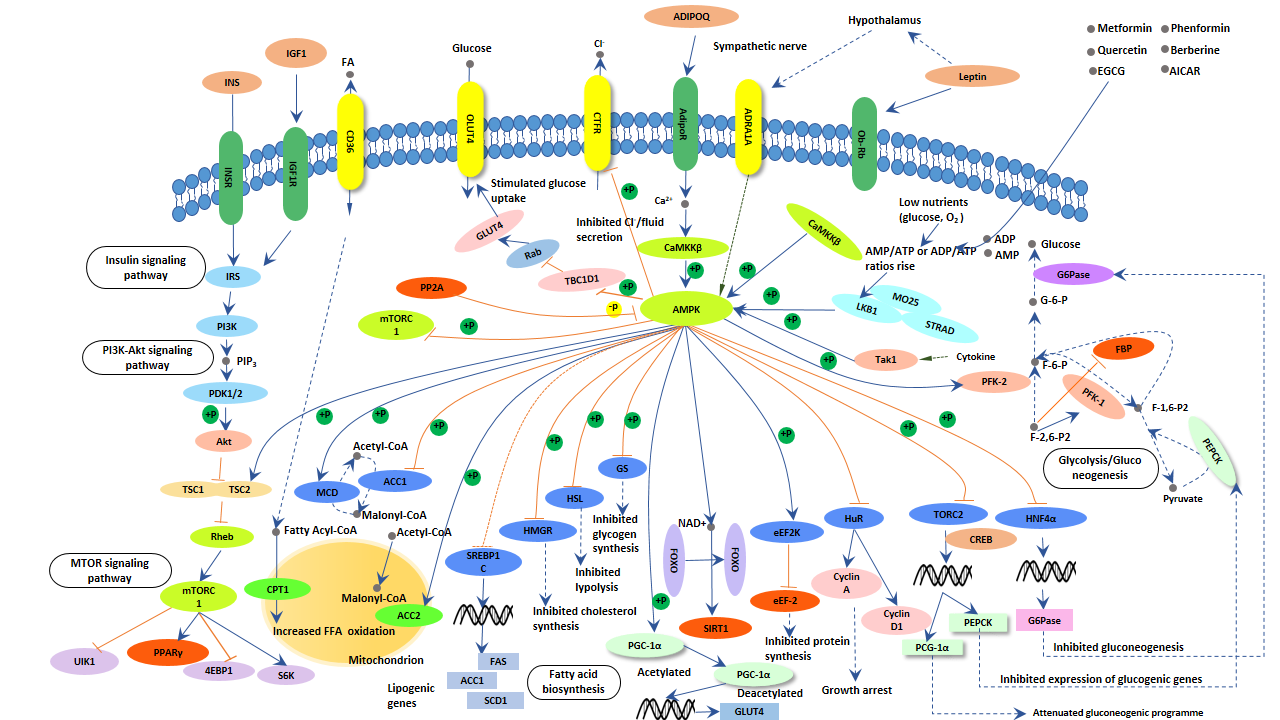
AMP-activated protein kinase (AMPK) serves as the master switch governing intracellular energy balance. It exerts decisive regulatory effects on cell proliferation, metabolic reprogramming, autophagy, and the establishment of proper cell polarity.
This kinase becomes activated under stress stimuli that deplete intracellular ATP reserves, such as glucose deprivation, hypoxic environments, tissue ischemia, and thermal shock. As a molecular sensor that detects low ATP concentrations, activated AMPK turns on downstream signaling events that restore cellular energy supplies. For instance, AMPK upregulates both transcription and plasma membrane translocation of GLUT4 protein, which significantly enhances insulin-dependent glucose uptake in target cells.
Functional AMPK exists as a heterotrimeric protein complex assembled from α catalytic subunit, β regulatory subunit, and γ regulatory subunit. Each subunit undertakes distinct tasks to sustain the structural integrity and full catalytic activity of the entire kinase complex.
As illustrated in ExKits’ pathway schematic, AMPK exerts dual regulatory effects on cellular metabolism: it directly phosphorylates dozens of rate-limiting metabolic enzymes, and modulates gene expression profiles via phosphorylation of transcription factors, co-activators and co-repressors. Given its central status in energy homeostasis modulation, AMPK has emerged as a promising therapeutic target for developing novel interventions against obesity, type 2 diabetes, metabolic syndrome, and various malignant tumors.
4.1 AMPK Signaling and Malignant Tumors
Research first uncovered the linkage between AMPK and tumorigenesis through the discovery that the LKB1 tumor suppressor transmits anti-oncogenic signals via AMPK to inhibit mTOR complex 1 (mTORC1), a kinase abnormally overactivated in most human cancers. Since this breakthrough, the LKB1-AMPK cascade has been widely recognized as a tumor-suppressive axis that restrains aberrant mTOR1 activity.
AMPK plays dual conflicting roles in tumor progression, comparable to a double-edged blade. On one hand, AMPK mitigates oxidative damage to normal somatic cells, thereby lowering the risk of tumor initiation and malignant transformation. On the other hand, once tumor lesions form, AMPK facilitates glucose and energy absorption by cancer cells. AMPK-mediated metabolic rewiring allows tumor cells to survive harsh nutrient-deficient microenvironments common in solid tumors.
To summarize, AMPK activation delivers protective effects against cancer onset, yet generates unfavorable outcomes for established tumor treatment. In contrast, targeted AMPK inhibition may serve as a viable therapeutic strategy for existing malignancies, as it impairs tumor cells’ stress tolerance and survival capacity.
4.2 AMPK Signaling and Type 2 Diabetes
Type 2 diabetes is a typical metabolic disorder marked by three core pathological features: insulin resistance, pancreatic β-cell functional impairment, and excessive hepatic glucose production. When cellular energy levels drop below thresholds, AMPK gets activated and initiates downstream signals to augment glucose uptake in skeletal muscle, accelerate fatty acid breakdown in adipose tissue, and curb hepatic gluconeogenesis. Cumulative clinical and preclinical data confirm disrupted AMPK activity in diabetic animal models and human patients. AMPK activation elevates cellular insulin sensitivity and restores systemic metabolic balance.
4.3 AMPK Signaling and Neurodegenerative Disorders
Classic neurodegenerative pathologies including Alzheimer’s disease, Parkinson’s disease and Huntington’s disease all feature progressive neuronal loss that eventually triggers dementia. These diseases share overlapping signaling disturbances and pathological hallmarks, such as impaired energy turnover, sustained oxidative stress, and excitotoxic nerve injury—all closely correlated with dysregulated AMPK activity. Brain tissue samples from neurodegenerative patients exhibit hyperactivated AMPK signals. Triggered by various intracellular stressors, excessive AMPK activation accelerates neuronal atrophy and apoptotic death, firmly placing aberrant AMPK signaling as a key driver of neurodegenerative disease progression.