
Blog

MAPK‑ERK Signaling Pathway
1
Definition of the MAPK‑ERK Signaling Pathway

Mitogen‑activated protein kinase (MAPK) signaling cascades represent a set of highly evolutionarily conserved signal transduction systems that exist across primitive prokaryotes and complex mammalian cells. Among all MAPK subfamilies, the MAPK‑ERK axis specializes in relaying extracellular stimuli from the cell surface deep into the cytoplasm and nucleus. After completing multi‑step kinase phosphorylation cascades, this pathway initiates a wide spectrum of cellular physiological outcomes, including cell cycle progression, clonal proliferation, cell lineage differentiation, malignant transformation, and programmed cell death (apoptosis). Its high conservation across species highlights its irreplaceable role in maintaining basic cellular homeostasis.
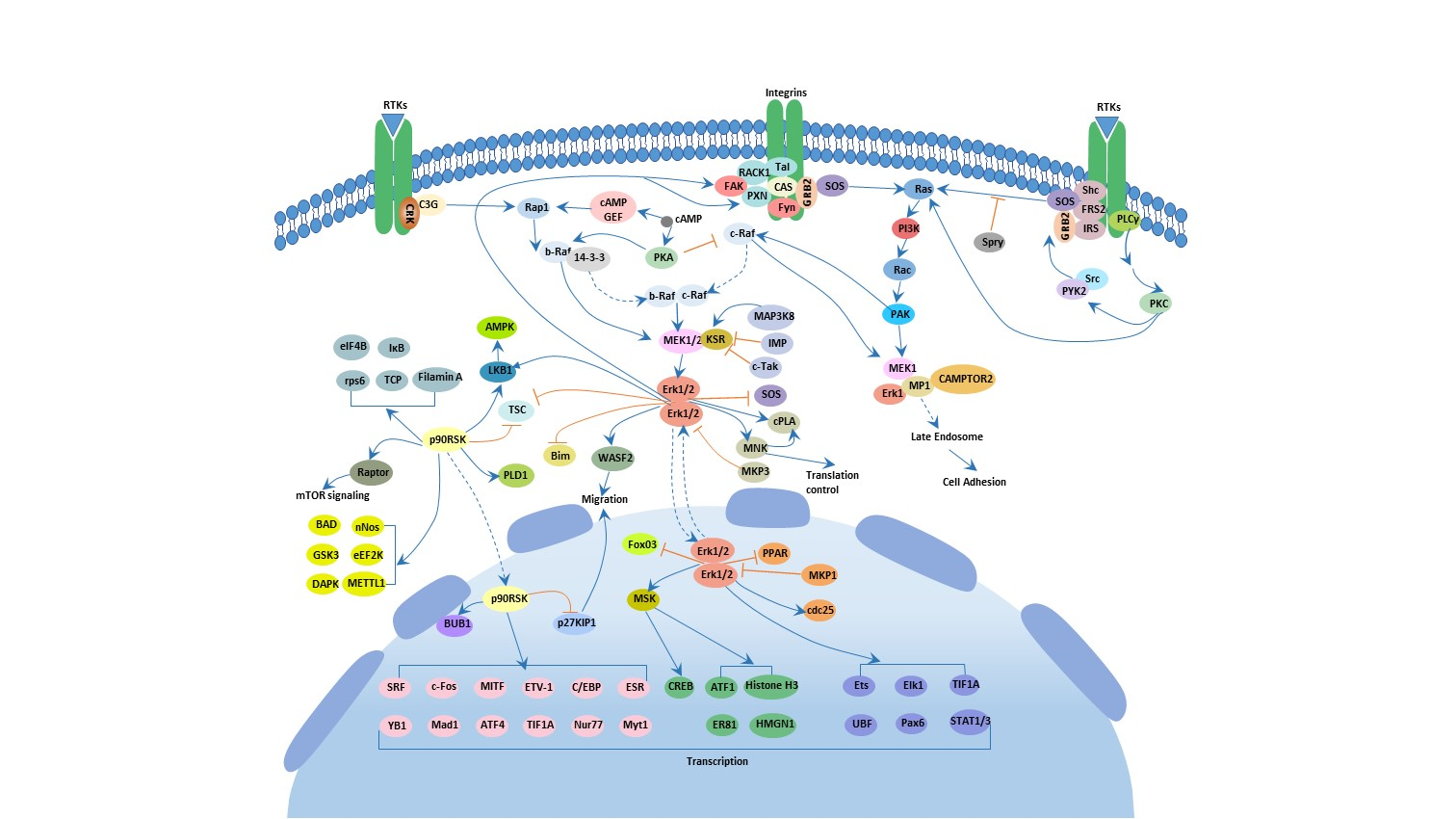
MAPK Erk pathway

2
Core Biological Functions of the MAPK‑ERK Signaling Pathway
The MAPK‑ERK cascade is also widely referred to as the Raf‑MEK‑ERK signaling axis, which stands as the most classical and well‑studied branch within the entire MAPK superfamily. Its core biological functions center on governing cell fate decisions, covering cell proliferation, neoplastic transformation, cell differentiation, and apoptotic regulation. This signaling module can be triggered by multiple classes of extracellular stimuli, including circulating hormones, endogenous growth factors, cell differentiation‑inducing cytokines, and exogenous tumor‑promoting chemical agents. The strength and duration of ERK activation determine the final cellular response, ranging from transient proliferation signals to permanent cell differentiation programs.
3
Stepwise Activation Mechanism of the MAPK‑ERK Signaling Pathway
The canonical activation cascade starts with three major types of membrane receptors: receptor tyrosine kinases (RTKs), G‑protein‑coupled receptors (GPCRs), and integrin adhesion receptors. These transmembrane receptors initiate signal transduction by activating small GTPase proteins, primarily Ras and its homologous Rap family members. Ligand binding induces receptor conformational rearrangement, which recruits adaptor proteins to catalyze the exchange of GDP bound to Ras for GTP, switching Ras into its biologically active conformation.
The inactivation state of Ras is tightly controlled by GTPase‑activating proteins (GAPs). GAPs enhance the intrinsic GTP hydrolysis activity of Ras, converting Ras‑GTP back to inactive Ras‑GDP to terminate upstream signaling. Once activated, membrane‑tethered Ras‑GTP recruits MAP3K family kinases, namely c‑Raf, A‑Raf and B‑Raf, to the plasma membrane and triggers their full activation. Activated Raf isoforms phosphorylate conserved serine residues on MEK1/2 (MAP2K family kinases), which serves as the exclusive upstream activator of ERK. MEK1/2 subsequently achieves dual phosphorylation of both threonine and tyrosine residues within the activation loop of ERK1/2, fully unlocking ERK catalytic activity.
Nuclear translocation of activated ERK1/2 enables direct phosphorylation of multiple core transcription factors, such as c‑Fos, c‑Jun, Elk‑1, c‑Myc and ATF2; these transcription factors directly bind gene promoter regions to modulate transcription programs controlling cell proliferation and differentiation. ERK also indirectly reshapes gene expression profiles by phosphorylating cytoplasmic substrates like p90‑RSK (ribosomal S6 kinase).
In addition to forward signal transduction, ERK participates in intrinsic negative feedback loops to avoid over‑signaling. It phosphorylates multiple upstream pathway components, including NGF receptors, SOS, Raf‑1 and MEK, to suppress sustained cascade activation. Independent research has also verified that cytoplasmic ERK phosphorylates cytoskeletal regulatory proteins such as MAP‑1, MAP‑2 and MAP‑4, which modulates cell morphology remodeling and intracellular cytoskeleton redistribution to regulate cell migration and adhesion.
4
Correlation Between Dysregulated MAPK‑ERK Signaling and Malignant Tumors
Tumorigenesis arises from cumulative genetic mutations and epigenetic modifications that disrupt the normal cellular growth surveillance network. Multiple core intracellular signaling cascades undergo pathological rewiring during malignant transformation, with the MAPK‑ERK pathway being one of the most frequently disturbed axes. Pathogenic mutations targeting RAS, RAF, MEK and ERK genes are detected in the majority of human solid tumors.
Mutant RAS proteins lose sensitivity to GAP‑mediated inhibition and remain persistently bound to GTP, leading to ligand‑independent, constitutive ERK1/2 activation. Oncogenic BRAF variants drive hyperactivation of downstream MEK and ERK1/2 without upstream growth factor stimulation. Meanwhile, abnormal overactivation of receptor tyrosine kinases is commonly observed in diverse human malignancies. All upstream molecular lesions converge to induce excessive ERK kinase activity. Hyperactive ERK phosphorylates and activates a large pool of downstream substrates, including CREB, c‑Myc, NF‑κB, AP‑1, ETS‑1 and STAT family transcription factors.
Phosphorylation of these substrates alters global gene expression and cellular motility, collectively accelerating tumor cell proliferation, differentiation disorder, invasive migration and angiogenesis. Overactivated ERK1/2 also upregulates anti‑apoptotic effector proteins such as BCL‑2, which effectively blocks tumor cell apoptosis and enhances tumor survival capacity. Given the tight causal link between aberrant MAPK‑ERK signaling and tumor progression, targeted intervention against this cascade and its downstream effector molecules has become a promising research direction for novel anti‑cancer therapeutic development.
   💬 WhatsApp