
FoxO Signaling Pathway
Introduction to FoxO Transcription Factors
The Forkhead box (Fox) protein superfamily consists of diverse transcription factors unified by a conserved winged-helix DNA-binding structural domain, which enables specific recognition and binding to target gene promoter sequences within cell nuclei. FoxO constitutes a distinct subbranch of the broader Fox family with evolutionarily conserved biological functions across mammalian species. Within human tissues, four canonical FoxO isoforms have been characterized: FoxO1, FoxO2, FoxO3a and FoxO4, each exhibiting tissue-specific expression patterns and partially overlapping yet unique transcriptional regulatory profiles.
Core Definition of the FoxO Signaling Cascade
The FoxO signaling cascade operates as a central molecular integration hub that converts extracellular nutritional, growth and stress signals into transcriptional outputs. Unmodified, functionally active FoxO proteins reside inside the nucleus, where they directly interact with promoter regions of hundreds of downstream target genes. Through this transcriptional control, FoxO coordinates a broad spectrum of core cellular physiological programs, serving as a master coordinator of cell homeostasis.
Multifaceted Biological Functions Mediated by FoxO Signaling
The FoxO signaling axis participates in nearly all fundamental cellular life activities, with well-documented core functions covering six major biological modules: programmed cell death (apoptosis), cell cycle progression and arrest, systemic glucose metabolic homeostasis, cellular antioxidant defense against oxidative stress, organismal lifespan and aging regulation, as well as immune cell differentiation and inflammatory balance. Beyond these core roles, emerging evidence also links FoxO activity to autophagic clearance, DNA damage repair and skeletal muscle atrophy, making this pathway indispensable for maintaining tissue and organismal stability.
Molecular Regulatory Mechanisms of the FoxO Signaling Pathway
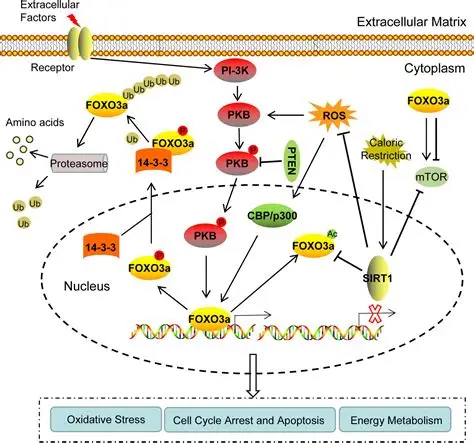
All human FoxO paralogs carry three highly evolutionarily conserved phosphorylation residues targeted by Protein Kinase B (PKB/Akt): Thr24, Ser256 and Ser319. The subcellular localization and transcriptional activity of FoxO proteins are tightly governed by the phosphorylation status of these three sites, creating a binary functional switch controlled by external stimuli.
State 1: Basal condition without growth factor/insulin stimulation
When cells lack insulin, IGF-1 or other mitogenic growth factor inputs, FoxO proteins remain unphosphorylated. Dephosphorylated FoxO accumulates stably within the cell nucleus, where it binds to conserved forkhead response elements on target gene promoters. This nuclear pool of active FoxO initiates transcription of functional gene clusters that modulate cell cycle checkpoint control, apoptotic signaling cascades, carbohydrate metabolism, antioxidant defense and immune homeostasis.
State 2: Activation of insulin/growth factor upstream signaling
Upon exposure to insulin or growth factor ligands, upstream PI3K-Akt signaling becomes activated. Catalytically active Akt phosphorylates FoxO at the three conserved residues, triggering a dramatic conformational shift in FoxO tertiary structure. The newly phosphorylated FoxO exposes a high-affinity binding pocket for 14-3-3 scaffold proteins; the FoxO–14-3-3 complex masks FoxO nuclear localization signals and exposes nuclear export sequences, driving the entire complex to translocate from the nucleus into the cytoplasmic compartment. Sequestration in the cytoplasm abolishes FoxO’s transcriptional capacity, leading to global downregulation of its downstream target gene expression.
Stress-triggered FoxO activation pathways
Contrary to Akt-mediated inhibitory phosphorylation, two major stress-responsive kinases counteract this suppression and restore FoxO transcriptional activity: stress-activated c-Jun N-terminal kinase (JNK) and energy-sensing AMP-activated protein kinase (AMPK). Both JNK and AMPK mediate dephosphorylation or alternative modification of FoxO proteins, promoting FoxO nuclear re-entry and boosting its DNA-binding capacity.
Beyond phosphorylation events mediated by Akt, JNK and AMPK, FoxO protein stability and activity are fine-tuned via multiple reversible post-translational modification systems, including lysine acetylation (regulated by CBP and SIRT1), site-specific methylation, and ubiquitination controlled by E3 ligases such as MDM2 and deubiquitinase USP7. These layered chemical modifications form a sophisticated regulatory network that calibrates FoxO function in response to dynamic intracellular and extracellular microenvironments.
Beyond phosphorylation events mediated by Akt, JNK and AMPK, FoxO protein stability and activity are fine-tuned via multiple reversible post-translational modification systems, including lysine acetylation (regulated by CBP and SIRT1), site-specific methylation, and ubiquitination controlled by E3 ligases such as MDM2 and deubiquitinase USP7. These layered chemical modifications form a sophisticated regulatory network that calibrates FoxO function in response to dynamic intracellular and extracellular microenvironments.