
Glucagon signaling pathway
What Is Glucagon and Its Mechanism of Action?
Glucagon (GCG) belongs to the peptide hormone family and is synthesized by pancreatic α-cells. When blood glucose concentrations drop below the normal range, α-cells specialized for glucagon synthesis secrete this hormone into systemic circulation. The liver serves as the primary target tissue for glucagon action. The hormone accelerates hepatic glycogen decomposition into free glucose molecules, which are then released into the bloodstream; this biochemical process is termed glycogenolysis.
Additionally, glucagon facilitates gluconeogenesis, a metabolic process that generates glucose using amino acid substrates. It simultaneously suppresses hepatic glucose consumption to maximize glucose efflux into blood circulation, maintaining stable glycemic levels. Overall, glucagon exerts antagonistic effects against insulin in glucose regulation, restricting blood glucose fluctuations within a narrow physiological range.
Additionally, glucagon facilitates gluconeogenesis, a metabolic process that generates glucose using amino acid substrates. It simultaneously suppresses hepatic glucose consumption to maximize glucose efflux into blood circulation, maintaining stable glycemic levels. Overall, glucagon exerts antagonistic effects against insulin in glucose regulation, restricting blood glucose fluctuations within a narrow physiological range.
Definition of the Glucagon Signaling Pathway
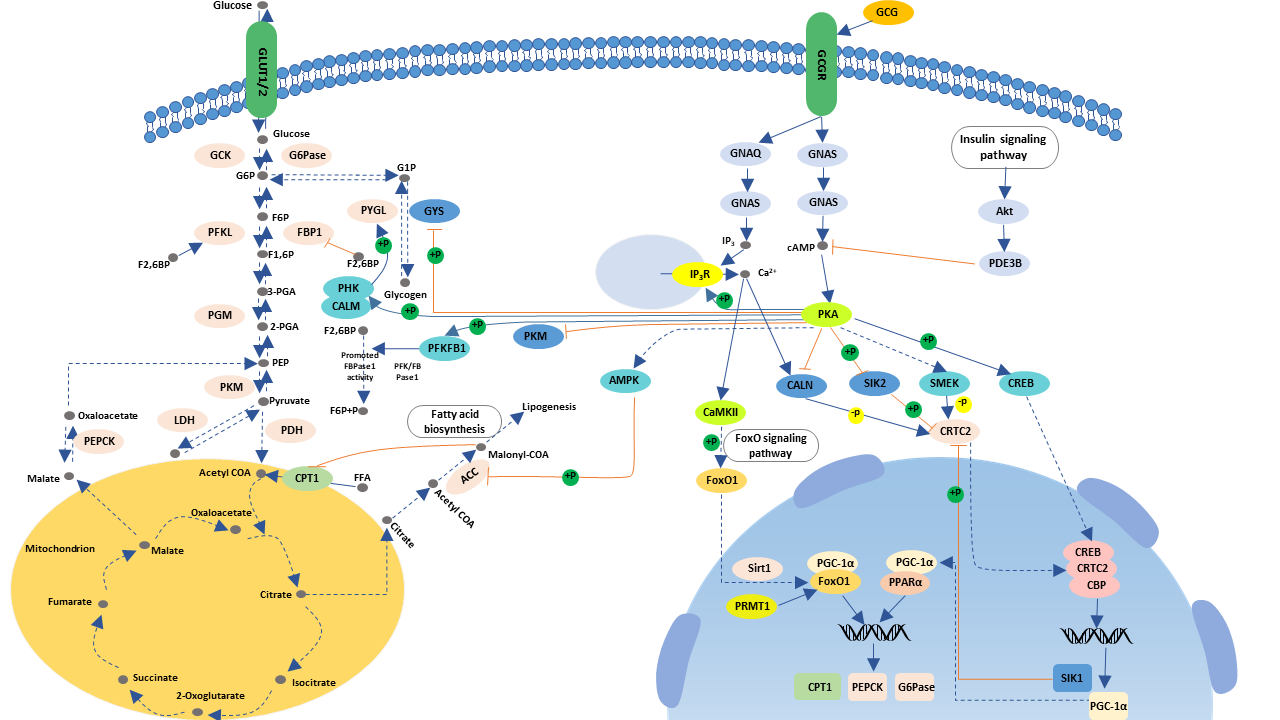
The glucagon signaling cascade refers to a series of enzymatic reactions that collectively elevate blood glucose concentrations. This cascade initiates when glucagon secreted from pancreatic islet α-cells binds to glucagon receptors located on the outer membrane of hepatocytes.
Biological Functions of the Glucagon Signaling Cascade
This signaling axis mediates glucagon’s hyperglycemic effects to sustain whole-body glucose homeostasis and acts in reciprocal coordination with insulin. In short, the glucagon pathway drives glucose catabolic reactions, exerting regulatory effects opposite to those triggered by insulin signaling.
Stepwise Mechanism of the Glucagon Signaling Cascade
The glucagon receptor (GCGR) is categorized as a Class B receptor within the large superfamily of seven-transmembrane G protein-coupled receptors. GCGR expression is predominantly detected on hepatocyte and renal cell surfaces. Under hypoglycemic conditions, pancreatic α-cells release glucagon. Upon binding to GCGR on target cell surfaces, glucagon induces structural conformational shifts in the receptor protein. This conformational change activates two major G protein subtypes coupled to the receptor: Gs and Gq.
cAMP-Dependent PKA Signaling Axis
Activated Gs subunits trigger adenylate cyclase activity, which converts adenosine triphosphate (ATP) into cyclic adenosine monophosphate (cAMP). As a secondary messenger, accumulated cAMP initiates downstream protein kinase A (PKA) signaling.
Elevated cAMP levels activate PKA, which subsequently phosphorylates glycogen phosphorylase kinase. This kinase modifies glycogen phosphorylase into its catalytically active α-form, launching hepatic glycogen breakdown (glycogenolysis). Meanwhile, PKA-mediated phosphorylation inactivates glycogen synthase, blocking de novo glycogen synthesis.
Beyond glycogen metabolism, PKA activated by cAMP stimulates lipase activity to accelerate lipid hydrolysis. The resulting rise in circulating glycerol and free fatty acids further reinforces hepatic gluconeogenesis.
Elevated cAMP levels activate PKA, which subsequently phosphorylates glycogen phosphorylase kinase. This kinase modifies glycogen phosphorylase into its catalytically active α-form, launching hepatic glycogen breakdown (glycogenolysis). Meanwhile, PKA-mediated phosphorylation inactivates glycogen synthase, blocking de novo glycogen synthesis.
Beyond glycogen metabolism, PKA activated by cAMP stimulates lipase activity to accelerate lipid hydrolysis. The resulting rise in circulating glycerol and free fatty acids further reinforces hepatic gluconeogenesis.
cAMP-Independent Calcium-Mediated PKA Signaling Axis
Activation of Gq subunits stimulates the phospholipase C–inositol trisphosphate signaling module, triggering intracellular calcium ion release. Calcium ions cooperate with PKA to activate ERK1/2 kinases. Phosphorylated ERK1/2 further activates CREB transcription factors.
Activated CREB binds to the promoter region of the PGC-1 gene to boost PGC-1 transcriptional expression. Elevated PGC-1 protein upregulates transcription of two key enzymes: glucose-6-phosphatase (G6Pase) and phosphoenolpyruvate carboxykinase (PEPCK), collectively boosting endogenous glucose production.
Glucagon also enhances mitochondrial β-oxidation in liver tissue, supplying energy substrates to support sustained glucose synthesis.
Activated CREB binds to the promoter region of the PGC-1 gene to boost PGC-1 transcriptional expression. Elevated PGC-1 protein upregulates transcription of two key enzymes: glucose-6-phosphatase (G6Pase) and phosphoenolpyruvate carboxykinase (PEPCK), collectively boosting endogenous glucose production.
Glucagon also enhances mitochondrial β-oxidation in liver tissue, supplying energy substrates to support sustained glucose synthesis.
Molecular Triggers for Glucagon Signaling Impairment
Genetic mutations and functional alterations of all protein components involved in glucagon signal transduction, alongside multiple metabolic disturbances, can disrupt normal signaling transmission. This aberrant cascade activity leads to hyperglycemia, making these dysfunctional signaling molecules promising therapeutic targets for high blood glucose and related metabolic disorders.
Diseases Linked to Abnormal Glucagon Signaling
Existing research confirms disrupted glucagon signaling drives hyperglycemia and induces pancreatic α-cell hyperproliferation. Excessively high glucagon secretion observed in type 2 diabetic patients arises not only from defective glucose feedback control and intrinsic pancreatic islet lesions, but also impaired hepatic glucagon signal transduction.
Clinical observations of glucagonoma patients reveal drastically reduced circulating amino acid levels. Pathologically elevated glucagon concentrations promote hepatic amino acid uptake for urea biosynthesis, a metabolic shift that causes severe hypoaminoacidemia. Glucagon is widely recognized as a potent modulator of hepatic amino acid metabolism and urea production.
Clinical observations of glucagonoma patients reveal drastically reduced circulating amino acid levels. Pathologically elevated glucagon concentrations promote hepatic amino acid uptake for urea biosynthesis, a metabolic shift that causes severe hypoaminoacidemia. Glucagon is widely recognized as a potent modulator of hepatic amino acid metabolism and urea production.
Most obese individuals exhibit concurrent dysfunction of pancreatic α and β cells: glucagon secretion becomes overactive while insulin output is compromised. This dual defect triggers severe systemic glucose metabolic imbalance. Therefore, comprehensive research into the glucagon signaling cascade provides critical theoretical support for developing novel obesity therapeutics.
Key Molecule Summary Table
| Abbreviation | Full Name | Core Biological Function |
|---|---|---|
| GCG | Glucagon | Hyperglycemic peptide hormone |
| GCGR | Glucagon Receptor | GPCR receptor for glucagon binding |
| PKA | Protein Kinase A | Primary downstream kinase of cAMP |
| CREB | cAMP Response Element-Binding Protein | Transcription factor regulating gluconeogenesis |
| PEPCK | Phosphoenolpyruvate Carboxykinase | Rate-limiting enzyme of hepatic gluconeogenesis |