
MAPK Signaling Pathway
1
Definition of the MAPK Signaling Pathway
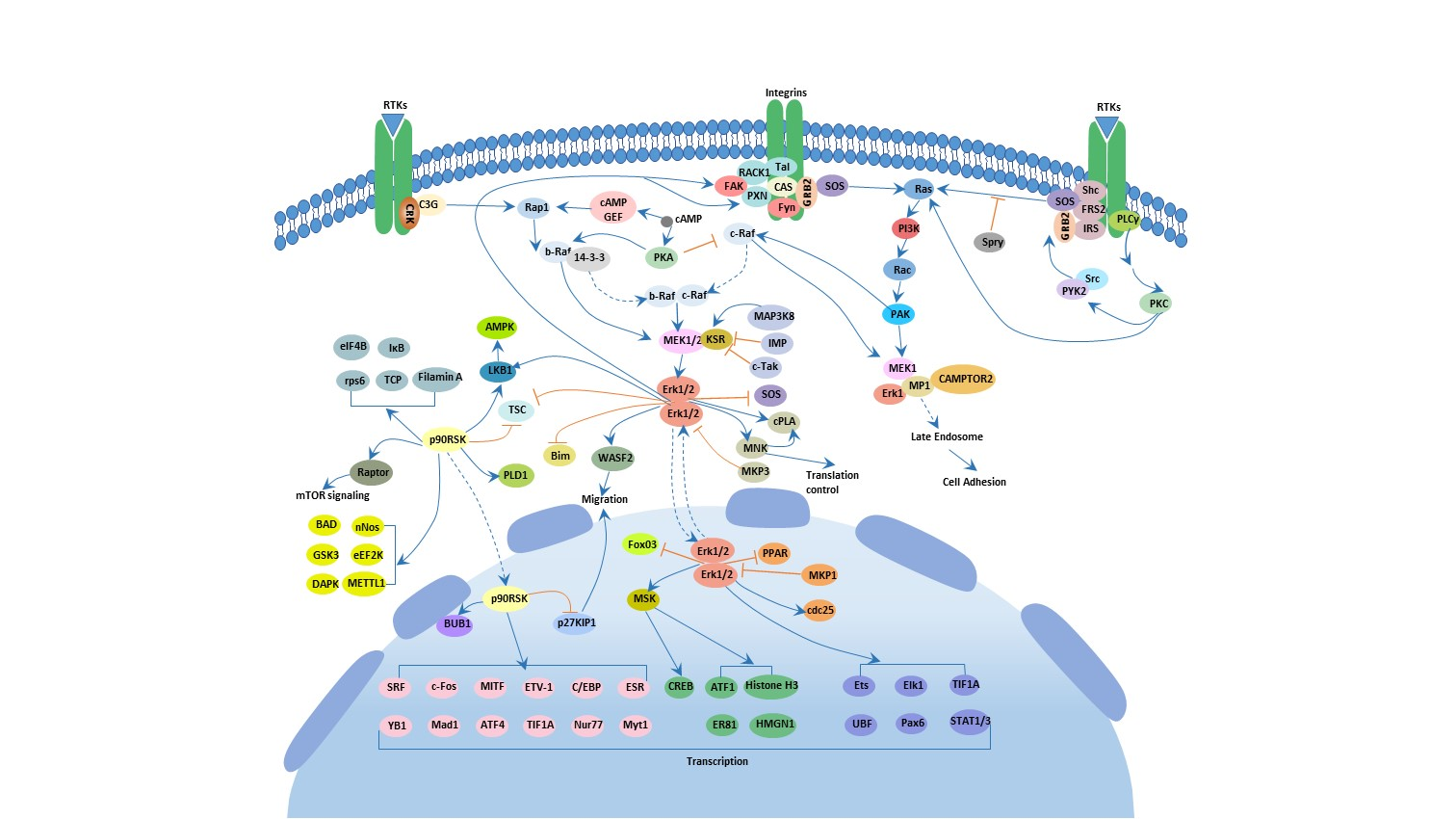
The mitogen‑activated protein kinase (MAPK) cascade refers to an evolutionarily conserved intracellular signaling module that governs multiple core cellular behaviors such as cell proliferation, differentiation and migratory movement. This signaling system consists of a wide array of functional protein molecules, among which ERK (extracellular signal‑regulated kinases) represents the initial identified subtype of MAPK family. It relays intracellular signals via sequential protein phosphorylation, acting as molecular switches to turn biological processes on or off.
2
Core Biological Functions of the MAPK Signaling Pathway
The MAPK cascade serves as an indispensable regulatory system controlling diverse cellular activities, including inflammatory reactions, stress response, cell differentiation, cell division, proliferative growth, metabolic homeostasis, cell motility and programmed cell death. Accumulated research has fully validated the vital involvement of abnormal MAPK signaling in tumor progression, autoimmune disorders and neurodegenerative lesions.
3
Activation Mechanism of the MAPK Signaling Pathway
Mammalian cells express four distinct subgroups of MAPK proteins with independent regulatory modes: ERK1/2, JNK1/2/3 (Jun amino‑terminal kinases), four isoforms of p38 (p38α/β/γ/δ), and ERK5. Each MAPK subtype is specifically triggered by its corresponding MAPKK kinase: MEK1/2 activates ERK1/2, MKK3/6 targets p38 proteins, MKK4/7 (also called JNKK1/2) stimulates JNKs, while MEK5 is the exclusive upstream activator for ERK5.
One single MAPKK can be phosphorylated and activated by multiple types of MAPKKK molecules, which greatly enriches the complexity and signal diversity of the entire MAPK network. Different MAPKKK proteins enable cells to respond selectively to distinct extracellular stimuli. The standard activation flow of the classical MAPK cascade starts at the cell membrane: small GTPases and various membrane‑anchored kinases phosphorylate MAPKKK proteins. Then activated MAPKKKs carry out phosphorylation and activation on downstream MAPKKs. Fully phosphorylated MAPKs subsequently modify a large number of cytoplasmic substrates, and further regulate the activity of nuclear transcription factors to initiate target gene expression matching cellular stimulation.
Despite being drawn as simple linear kinase chains in most pathway diagrams, the MAPK network possesses sophisticated internal regulatory logic. Extensive signal crosstalk exists between different MAPK branches and other major signaling axes. Well‑documented interactive relationships have been discovered between MAPK mediators and components of the PI3K, NFκB as well as JAK‑STAT signaling pathways.
4
Correlation Between Abnormal MAPK Signaling and Tumor Development
The MAPK cascade closely coordinates cell proliferative growth and differentiation processes. Persistent hyperactivation of MAPK signaling can be detected in numerous malignant tumors, and uncontrolled cell proliferation acts as a core driver of tumor formation, while metastasis and invasion represent the primary lethal factors of cancers. Among all mammalian MAPK branches, the ERK cascade has been most thoroughly investigated, and dysregulated ERK signaling occurs in nearly one‑third of human malignant lesions. The ERK1/2 axis exerts decisive regulatory effects on tumor cell proliferation, differentiation, invasive migration and distant metastasis.
Research led by Wen‑Horng Wang demonstrated that the X protein derived from hepatitis B virus suppresses the functional activity of the p53 tumor suppressor through abnormal p38 MAPK signaling, ultimately inducing primary liver carcinoma. Another study conducted by Kim MS verified that p38 MAPK acts as a central signaling mediator for Ras‑triggered invasion and metastasis of breast tumor cells. Multiple research groups have confirmed that the p38 cascade regulates the synthesis and secretion of matrix metalloproteinases (MMPs) induced by extracellular stimuli; MMPs are proteolytic enzymes closely linked to tumor invasion and migratory capacity. Moreover, activated p38 signaling facilitates tumor angiogenesis, which supplies nutrients to sustain continuous tumor expansion.
Tumor tissues frequently face harsh microenvironmental stress including hypoxia and chronic inflammation, and multiple MAPK branches participate in stress signal transduction within cancer cells. Various kinases get activated under inflammatory stimulation, DNA damage or apoptotic pressure inside tumors. Hypoxia is a common feature of solid tumor masses; hypoxic signals upregulate the activity of MKP‑1, which further stimulates SAPK/JNK signaling and promotes the activation of c‑Jun protein. Activated c‑Jun initiates transcription of numerous downstream genes that support tumor cell proliferation and survival.
Malfunctions across the MAPK cascade interfere with nearly every stage of tumorigenesis and are critical drivers of tumor initiation and advancement. Multiple oncogenic alterations can lead to permanent ERK overactivation, such as overexpression or gain‑of‑function mutations of receptor tyrosine kinases, sustained secretion of autocrine/paracrine activating ligands, and activating mutations on Ras or B‑Raf genes. Existing research also indicates that elevated JNK activity and c‑Jun phosphorylation are essential drivers of Ras‑mediated tumorigenesis.