
Insulin Signaling Pathway
What is Insulin?
Blood glucose levels will naturally rise following food intake. In response to elevated blood sugar, the beta cells located in the pancreatic islets synthesize and secrete insulin to maintain blood glucose concentrations within a stable physiological range. As a critical protein hormone in the human body, insulin functions like a molecular key that unlocks peripheral tissue cells, facilitating the uptake and internalization of circulating glucose into intracellular compartments and effectively lowering blood glucose levels.
The Biological Functions of Insulin
Insulin is the sole endogenous hormone capable of reducing blood glucose in humans and other mammals. Once insulin binds to specific membrane receptors on target cells, it accelerates the transmembrane transport of extracellular glucose into cells, where excess glucose is stored in the form of glycogen. Meanwhile, insulin exerts an inhibitory effect on glycogenolysis, preventing the breakdown of stored glycogen back into free glucose and further stabilizing blood glucose homeostasis.
In addition to its core hypoglycemic function, insulin participates in the regulation of lipid and protein metabolism. It promotes the anabolic synthesis of proteins and fatty acids in peripheral tissues and blocks the gluconeogenesis process that converts lipids and proteins into glucose. Insufficient insulin secretion or impaired insulin bioactivity leads to persistent hyperglycemia, which is a primary pathological driver of diabetes mellitus.
Overview of the Insulin Signaling Pathway
The insulin signaling pathway is a sophisticated intracellular signal transduction cascade that dominates the regulation of systemic glucose and lipid metabolism. Through a series of sequential molecular activation and phosphorylation reactions, this pathway precisely modulates metabolic balance and maintains whole-body glucose homeostasis, working synergistically with counter-regulatory hormones such as glucagon to adapt blood glucose levels to physiological and nutritional states.
Physiological Functions of the Insulin Signaling Pathway
The primary physiological role of the insulin signaling pathway is to mediate the hypoglycemic and metabolic regulatory effects of insulin. It coordinates multiple downstream molecular cascades to balance glucose uptake, glycogen synthesis, gluconeogenesis, lipolysis and protein anabolism. Together with glucagon and other regulatory factors, this pathway maintains dynamic blood glucose stability under fasting and postprandial conditions, supporting normal energy metabolism and cellular physiological activities.
Molecular Mechanism of the Insulin Signaling Pathway
The insulin receptor (InsR) belongs to the transmembrane receptor tyrosine kinase family, existing as a tetrameric complex composed of two extracellular α-subunits and two transmembrane β-subunits linked by disulfide bonds. The extracellular α-subunits are responsible for specific binding to circulating insulin molecules, while the transmembrane β-subunits undertake intracellular signal transduction tasks.
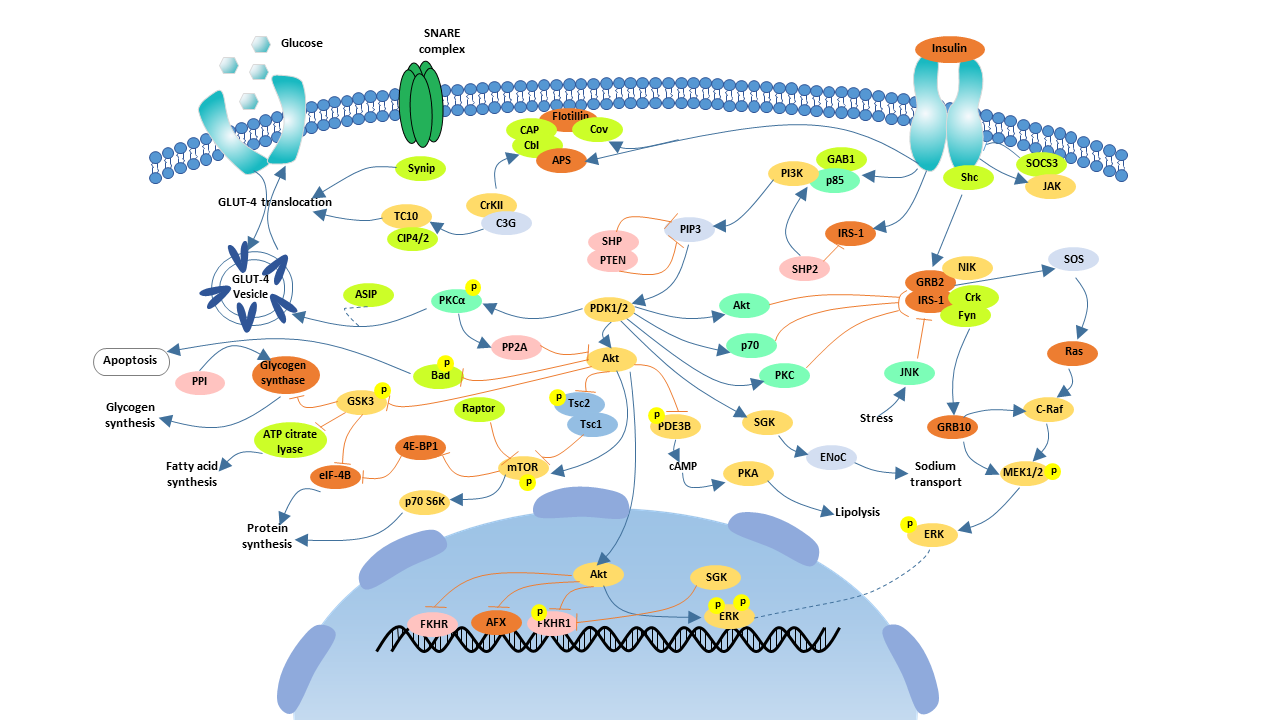
When insulin binds to the α-subunit of InsR on the surface of target cells, it triggers a conformational change in the β-subunit, thereby activating the intrinsic tyrosine kinase activity of the receptor. Activated InsR initiates autophosphorylation of its intracellular tyrosine residues, which further induces the phosphorylation and activation of downstream insulin receptor substrate (IRS) family proteins, mainly IRS1 and IRS2. The activated IRS proteins subsequently trigger two major downstream signaling cascades: the PI3K/Akt pathway and the Ras-Raf-MEK-MAPK pathway.
PI3K/Akt Signaling Pathway
The PI3K/Akt cascade serves as the core downstream pathway mediating insulin-dependent metabolic regulation. Upon activation by phosphorylated IRS1, phosphatidylinositol 3-kinase (PI3K) catalyzes the phosphorylation of membrane-bound phosphatidylinositol (PI), generating two key secondary messengers: phosphatidylinositol 4,5-bisphosphate (PIP2) and phosphatidylinositol 3,4,5-triphosphate (PIP3).
PIP3 accumulates on the intracellular membrane and recruits two critical signaling molecules, Akt and 3-phosphoinositide dependent protein kinase-1 (PDK1), to the membrane region. The recruited PDK1 further phosphorylates the serine and threonine active sites of Akt, thereby fully activating Akt kinase activity. The phosphatase PTEN acts as a negative regulator of this pathway by dephosphorylating PIP3 to terminate signal transduction.
Activated Akt executes multiple metabolic regulatory functions. It promotes the translocation of glucose transporter 4 (GLUT4) from intracellular vesicles to the plasma membrane in muscle and adipose tissues, significantly enhancing cellular glucose uptake and utilization. Moreover, Akt phosphorylates and inactivates glycogen synthase kinase-3 (GSK3), which relieves the inhibitory effect of GSK3 on glycogen synthase (GS), thereby accelerating glycogen synthesis and reducing blood glucose.
In terms of protein metabolism, GSK3 inactivation promotes the activation of eukaryotic translation initiation factor 2B, facilitating insulin-mediated protein synthesis. Additionally, the mTOR/4E-BP1 signaling axis downstream of Akt regulates protein translation and anabolism at the post-transcriptional level. Beyond metabolic regulation, the PI3K/Akt pathway is crucial for maintaining pancreatic beta cell survival, regulating cell proliferation, differentiation and apoptosis, and preserving normal pancreatic endocrine function.
MAPK Signaling Pathway
The mitogen-activated protein kinase (MAPK) pathway represents another major downstream branch of insulin signaling, mainly responsible for regulating cell growth, proliferation and gene expression. This pathway is activated when growth factor receptor-bound protein 2 (Grb2) binds to tyrosine-phosphorylated Shc protein or directly interacts with activated insulin receptors.
Grb2 further recruits and activates the mammalian son of sevenless (mSOS), a guanine nucleotide exchange factor that promotes the conversion of Ras-bound GDP to GTP, switching Ras to its active state. Membrane-anchored active Ras recruits Raf kinase to the cell membrane for activation, and activated Raf subsequently phosphorylates and activates MEK (MAPK/Erk kinase). Finally, MEK triggers the phosphorylation and activation of extracellular signal-regulated kinase 1/2 (ERK1/2).
Activated ERK1/2 translocates into the nucleus and modulates the activity of multiple transcription factors, including ELK1 and FOS associated with cell proliferation, as well as Twist and ZEB1 involved in epithelial-mesenchymal transition (EMT). This process upregulates the expression of cell cycle regulatory proteins and oncogenes, thereby promoting cell growth, division and protein synthesis. Furthermore, insulin-induced GSK3β phosphorylation and inactivation activates downstream oncogenes and transcription factors, further facilitating cell proliferation processes.
Causes of Insulin Signaling Pathway Dysfunction
Dysfunction of the insulin signaling pathway is primarily attributed to genetic variations and functional abnormalities of key signaling proteins within the cascade. Molecular defects in upstream receptors, intermediate kinases or downstream effector proteins can disrupt normal signal transduction efficiency, ultimately inducing insulin resistance. In addition, multiple inflammatory cytokines and metabolic regulatory factors such as TNF-α can indirectly interfere with insulin signal transmission, exacerbating insulin resistance. These molecular and pathological abnormalities are core therapeutic targets for insulin resistance and related metabolic disorders.
Diseases Associated with Insulin Signaling Pathway Disorders
Insulin resistance is fundamentally caused by impaired or attenuated insulin signal transduction. Any functional defect or structural damage in any link of the insulin signaling cascade can lead to systemic insulin resistance, which is the core pathological basis of metabolic syndrome and type 2 diabetes mellitus.
Emerging preclinical studies have demonstrated that dysfunction of the insulin-mediated PI3K/Akt signaling pathway is closely correlated with the occurrence and progressive deterioration of Alzheimer’s disease in animal models. Defective central insulin signaling accelerates neuronal metabolic disorders and abnormal protein aggregation, promoting neurodegeneration.
Moreover, recent experimental evidence indicates that improving central insulin metabolism and restoring impaired insulin signaling can effectively alleviate the pathological symptoms of multiple neuropsychiatric disorders, including schizophrenia and depression, suggesting the crucial regulatory role of insulin signaling in central nervous system function and mental health.