
Targeted cancer therapeutics have achieved remarkable advancement in recent years. Conventional druggable targets mainly encompass G-protein coupled receptors, nuclear receptors, ion channels and various enzymes. Nevertheless, roughly 80% of human proteins are still classified as "undruggable", meaning conventional small-molecule inhibitors cannot bind these proteins effectively to generate desired therapeutic effects. Global research groups have invested tremendous efforts to upgrade traditional small-molecule drug design strategies.
A transformative targeted intervention approach has since emerged: PROTAC, short for Proteolysis Targeting Chimera. This technology enables targeted elimination of disease-relevant proteins independent of their functional features, unlocking the opportunity to modulate previously undruggable protein targets and drastically expand the target spectrum for new drug development. Looking back to March 2019, the first PROTAC candidate entered human clinical trials. Within just a few years, more than 200 distinct targeted protein degrader molecules (predominantly PROTAC constructs) have advanced to different clinical trial phases. To clarify how PROTAC accelerates drug discovery workflows, this article systematically reviews the technical fundamentals of PROTAC and outlines its future translational prospects.
Proteolysis Targeting Chimeras (PROTAC) represent an innovative strategy for targeted protein degradation. Back in 2001, Professor Craig Crews and Professor Raymond Deshaies first put forward the conceptual framework of PROTAC and synthesized the inaugural PROTAC molecule PROTAC-1 designed to degrade methionyl aminopeptidase-2 (METAP2), laying the foundational work for this novel technical route. In 2008, the Crews research team recruited MDM2 E3 ligase via Nutlin ligands to trigger the degradation cascade against androgen receptor (AR). This small bifunctional molecule tethers AR close to MDM2, facilitating ubiquitination of AR and subsequent proteasomal breakdown. Such chimeric molecules capable of redirecting specific proteins toward degradation pathways were formally named PROTAC (Proteolysis Targeting Chimera).
At present, PROTAC has garnered extensive attention from oncology drug developers worldwide. Multiple customized PROTAC degraders have been synthesized to downregulate disease-driving proteins, serving as an alternative therapeutic modality for cancer treatment. Unlike traditional inhibitors that occupy protein active pockets, PROTAC reroutes target proteins into endogenous cellular degradation machineries to permanently abolish protein function. Furthermore, this modality can effectively circumvent drug resistance frequently observed with classic small-molecule agents. At present, numerous biopharma enterprises, academic laboratories and investment institutions are actively advancing PROTAC research and development programs.
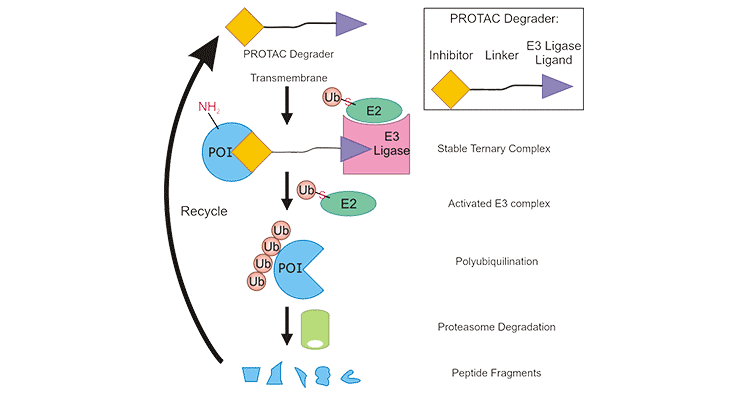
The Ubiquitin-Proteasome System (UPS), also known as ubiquitin-dependent protein degradation machinery, serves as the physiological pathway exploited by PROTAC to eliminate target proteins. This system is responsible for degrading over 80% of intracellular proteins, clearing damaged or functionally redundant proteins inside cells. Dysfunction of UPS-mediated protein turnover frequently triggers severe illnesses including malignant tumors.
Mechanistically, ubiquitin molecules collaborate with three classes of enzymes to sort intracellular proteins: selected substrate proteins undergo site-specific ubiquitin modification and form polyubiquitin chains, which are then recognized and degraded by the 26S proteasome. Three core enzyme families participate in this cascade: E1 ubiquitin-activating enzymes, E2 ubiquitin-conjugating enzymes, and E3 ubiquitin ligases.
The UPS-mediated protein degradation cascade proceeds through four key steps:
- Ubiquitin activation by E1: With ATP energy supply, the C-terminal glycine residue of ubiquitin (Ub) forms a high-energy thioester bond with the cysteine residue on E1;
- Activated Ub is transferred from E1 to E2 via Ub-adenylate intermediates, generating E2-Ub thioester complexes;
- E3 ubiquitin ligases, the specificity-determining component of UPS, recognize and recruit individual substrate proteins;
Polyubiquitinated substrates are captured and fully degraded by the proteasome complex.
All conventional PROTAC molecules adopt a three-component modular architecture: a ligand binding the protein of interest (POI), a ligand recruiting an E3 ubiquitin ligase, and a chemically optimized linker connecting the two ligands. As bifunctional molecules, PROTAC simultaneously engage the target protein and E3 ligase, forcing proximity between them. This induced proximity enables ubiquitination of POIs that cannot naturally interact with E3 ligases, leading to proteasomal recognition and complete degradation.
In contrast to traditional kinase inhibitors that rely on active-site occupancy, PROTAC technology works effectively against proteins lacking well-defined druggable active pockets. This property greatly broadens the design space of small-molecule therapeutic agents and allows researchers to repurpose existing E3 ligase recruiters to tackle previously inaccessible protein targets.
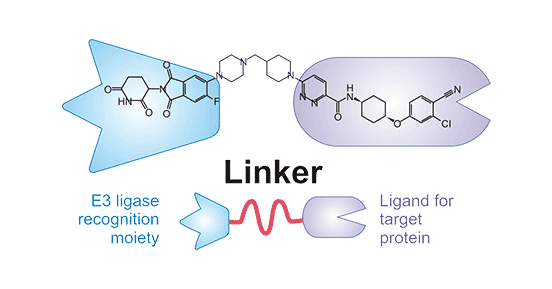
Formation of the POI–PROTAC–E3 ligase ternary complex constitutes the core step enabling PROTAC-driven substrate degradation, and this assembly is an indispensable prerequisite for POI polyubiquitination. PROTAC molecules only exert degradation activity once they simultaneously bind both the target protein and E3 ligase to establish the ternary complex.
Human genome encodes more than 600 distinct E3 ubiquitin ligases, several of which have been incorporated into PROTAC molecular design, including CRBN, VHL (inhibitor of apoptosis proteins), IAP family members, MDM2 and DCAF16. Among clinical-stage PROTAC pipelines disclosed publicly, CRBN remains the most commonly recruited E3 ligase. Additional research has validated tissue-specific E3 ligases with potential PROTAC application value: KLHL41 enriched in skeletal muscle, RNF182 and TRIM9 expressed in nervous tissue, as well as CDC20, CIAO1 and WD82 upregulated in tumor tissues, which will further diversify PROTAC design options.
Meanwhile, PROTAC design has targeted a broad panel of disease-relevant proteins:
- Nuclear receptors: ER, AR, RAR;
- Protein kinases: AKT, RIPK2, CDK9, TBK1, BTK, BCR-ABL, CDK2/4/6/9, ALK, CK2, PI3K, ERK1/2;
- Transcriptional regulators: BRD4, Sirt2, TRIM24, HDAC6;
- Regulatory proteins: ERRα, FKBP12, TACC3;
- Neurodegeneration-related proteins: Huntingtin, Tau, α-synuclein;
- Metabolic enzymes: MetAP-2, DHODH;
- Epigenetic modulators: PCAF/GCN5.
In total, over 30 wild-type and mutant protein targets have been validated for PROTAC development.
PROTAC overturns the classic pharmacological logic of small-molecule inhibitors by permanently eliminating target proteins via the endogenous UPS pathway. It delivers robust therapeutic effects at low dosing levels and mitigates onset of acquired drug resistance, while granting access to undruggable targets. Up to now, PROTAC technology has progressed into clinical trials for prostate cancer, breast cancer, non-small cell lung carcinoma and multiple other malignancies, with validated degraders against AR, ER, EGFR, KRAS and ABL advancing clinically.
Prostate cancer ranks among the most prevalent malignancies in the male population, with androgen receptor (AR) serving as a pivotal diagnostic and therapeutic biomarker. AR antagonists such as enzalutamide initially yield satisfactory clinical responses, yet secondary drug resistance inevitably emerges in most patients. AR-targeting PROTAC degraders consistently outperform enzalutamide, particularly in cases where AR point mutations transform antagonists into AR agonists. Multiple AR-directed PROTAC candidates are currently undergoing clinical evaluation for resistant prostate cancer treatment.
Approximately 70% of breast cancer patients are estrogen receptor α (ERα)-positive, rendering ERα a core therapeutic target for breast oncology. Primary ER-positive tumors frequently develop resistance to endocrine therapeutics including fulvestrant. ER-recruiting PROTAC molecules induce complete ERα degradation and display optimized pharmacokinetic and pharmacodynamic profiles compared with classic antagonists.
Beyond ERα, researchers have constructed corresponding PROTAC degraders against other breast cancer drivers, including CDK4/6, HER2, PARP1, TACC3 and BET family proteins (BRD2, BRD3, BRD4, BRDT), which demonstrate robust protein knockdown efficacy at cellular levels . These investigations confirm that PROTAC-mediated targeted protein degradation holds great promise as an innovative intervention strategy for breast cancer management.
Epidermal Growth Factor Receptor (EGFR), a receptor tyrosine kinase (RTK), governs cell proliferation, apoptosis, metabolism and survival signaling. EGFR activating mutations occur in 10%–15% of NSCLC patients, making EGFR inhibitors a dominant drug development focus. Nevertheless, acquired resistance severely limits long-term treatment efficacy, driving multiple research teams to develop EGFR-targeting PROTAC degraders .
KRAS represents another high-value NSCLC therapeutic target regulating cell survival and cell cycle progression. In 2020, the Crews lab reported the first KRAS G12C-selective PROTAC degrader, marking a landmark breakthrough for PROTAC intervention against traditionally undruggable RAS family proteins. Additionally, roughly 4% of NSCLC patients carry ALK gene fusions, and ALK-targeted PROTAC degraders are expected to offer new therapeutic choices for patients with ALK inhibitor-resistant mutations.
BCR-ABL kinase inhibitors have drastically improved survival outcomes for CML patients; however, kinase inhibition cannot achieve curative effects for the majority of patients. PROTAC degraders capable of eliminating full-length BCR-ABL exhibit excellent target selectivity, robustly suppress proliferation of BCR-ABL-positive leukemic cells and block downstream oncogenic signaling cascades Multiple novel CML-targeted PROTAC degraders have now entered clinical development phases.
Apart from depleting oncogenic driver proteins in cancers, PROTAC technology shows potential for treating protein aggregation disorders. α-synuclein and Tau protein aggregates are tightly linked to the onset and progression of multiple neurodegenerative diseases. Direct recruitment of these pathogenic proteins to E3 ligases via PROTAC constructs enables their clearance, providing a viable therapeutic strategy for neurodegeneration and proteinopathy treatment. Several research groups have validated Tau-degrading PROTAC candidates as potential Alzheimer’s disease therapeutics.
Zou, Yutian, Danhui Ma, and Yinyin Wang. "The PROTAC technology in drug development." Cell biochemistry and function 37.1 (2019): 21-30.
Békés, Miklós, David R. Langley, and Craig M. Crews. "PROTAC targeted protein degraders: the past is prologue." Nature Reviews Drug Discovery 21.3 (2022): 181-200.
- Han, Xin, Wenyi Wei, and Yi Sun. "PROTAC degraders with ligands recruiting MDM2 E3 ubiquitin ligase: an updated perspective." Acta Materia Medica (2022).
- Cecchini, Carlotta, et al. "Exploring the ubiquitin-proteasome system (UPS) through PROTAC technology." Chimia 74.4 (2020): 274-274.
- Li, Xinyi, et al. "Therapeutic targeting of RNA-binding protein by RNA-PROTAC." Molecular Therapy 29.6 (2021): 1940-1942.
- Bondeson, Daniel P., et al. "Lessons in PROTAC design from selective degradation with a promiscuous warhead." cell chemical biology 25.1 (2018): 78-87.
- Pagan, Julia, et al. "Role of the ubiquitin proteasome system in the heart." Circulation research 112.7 (2013): 1046-1058.
- Nalawansha, Dhanusha A., and Craig M. Crews. "PROTACs: an emerging therapeutic modality in precision medicine. "Cell chemical biology 27.8 (2020): 998 -1014.
- Gao, Hongying, Xiuyun Sun, and Yu Rao. "PROTAC technology: opportunities and challenges." acs medicinal chemistry letters 11.3 (2020): 237-240.
- Paiva, Stacey-Lynn, and Craig M. Crews. "Targeted protein degradation: elements of PROTAC design. "Current opinion in chemical biology 50 (2019): 111- 119.
- Kargbo, Robert B. "PROTAC degradation of IRAK4 for the treatment of cancer." ACS Medicinal Chemistry Letters 10.10 (2019): 1370-1371.
- Wang, Chao, et al. "PROTACs technology for targeting non-oncoproteins: Advances and perspectives." Bioorganic Chemistry 114 (2021): 5109.
- Petrylak, Daniel Peter, et al. "First-in-human phase I study of ARV-110, an androgen receptor (AR) PROTAC degrader in patients (pts) with metastatic castrate-resistant prostate cancer (mCRPC) following enzalutamide (ENZ) and/or abiraterone (ABI)." (2020): 3500-3500.