
DNA Damage, Mutations and Cellular Repair Systems
DNA carries an organism’s genetic information and is essential for its survival and reproduction. For this reason, preserving the structural integrity of DNA molecules is vital to all living cells. Nonetheless, DNA inevitably sustains various forms of damage during replication and genetic transmission to daughter cells. This article elaborates on the definition, major triggers and distinct features of DNA damage, and further clarifies the differences between DNA damage and gene mutation. It also systematically introduces major damage categories, cellular response pathways and related human diseases.
1. Definition of DNA Damage
DNA damage refers to any structural changes that disrupt the natural double-helix conformation of DNA. Such molecular lesions commonly arise in nearly all cellular organisms.
2. Primary Causes of DNA Damage
Factors leading to DNA damage are broadly divided into two major groups: internal factors generated inside cells and external factors from the surrounding environment. Endogenous lesions mainly stem from replication errors and spontaneous chemical reactions within cells. Exogenous triggers can be further classified into physical and chemical hazards.
3. Major Types of DNA Damage
Throughout their lifespan, cells are constantly exposed to DNA-damaging threats from both internal metabolism and external surroundings.
3.1 Endogenous DNA Damage
Statistics indicate that a single mammalian cell undergoes roughly 100,000 spontaneous DNA lesions every single day.
3.1.1 Errors Occurring in DNA Replication
DNA replication follows strict base-pairing rules and proceeds with high precision, yet it is not entirely error-free. The inherent error rate of random base pairing ranges from 10⁻¹ to 10⁻². With the proofreading function of DNA polymerases, this error rate drops to approximately 10⁻⁵ to 10⁻⁶. When mismatched nucleotides appear during synthesis, polymerases will temporarily halt the catalytic process. Even so, a small number of base mismatches can escape proofreading and mismatch correction systems. When the DNA template is already impaired, translesion synthesis (TLS) polymerases with low fidelity become a key source of spontaneous mutations. Additionally, faults can also be induced by topoisomerase activity and abnormal uracil incorporation.
While most DNA replication proceeds with high accuracy, occasional mistakes still occur, including base insertions and deletions. Spontaneous errors during synthesis may also lead to incorrect nucleotide integration in newly formed DNA strands, resulting in mismatched base pairs.
3.1.2 Hydrolysis-Induced DNA Damage
Hydrolytic damage mainly includes base deamination and base loss, which are often driven by intracellular metabolic products and excessive reactive oxygen species (ROS).
• Base deamination
Nitrogenous bases with amino groups can undergo spontaneous deamination, forming abnormal base combinations such as cytosine to uracil (C-U), adenine to hypoxanthine (A-I) and guanine to xanthine (G-X). Notably, base deamination happens far more frequently in single-stranded DNA than in double-stranded DNA. Therefore, the transient single-stranded state during DNA replication, transcription and gene recombination will aggravate this type of damage and eventually cause permanent mutations if repair fails.
• Base loss
Loss of DNA bases creates apurinic or apyrimidinic (AP) sites. These abnormal sites are highly mutagenic and can block normal transcription if left unrepaired. Base loss occurs constantly in living organisms: each E. coli cell loses roughly one purine base per cell division cycle, while mammalian cells lose about 10,000 purines daily.
• Base tautomerism
The four standard DNA bases can spontaneously switch between different tautomeric forms, such as the interconversion between keto and enol structures. Such structural shifts alter hydrogen bonding patterns between paired bases.
3.1.3 Damages Caused by Intracellular Metabolic Byproducts
Reactive oxygen species (ROS) are well-known triggers of DNA damage. Oxygen free radicals can attack the double bonds on nitrogenous bases and trigger ring-opening reactions. They also destroy the ribose-phosphate backbone of DNA and induce single-strand breaks, producing effects similar to ionizing radiation.
3.2 Exogenous DNA Damage
External DNA damage is mainly caused by physical radiation and harmful chemical substances in the environment.
3.2.1 Physical factors
The most prevalent physical hazards are ionizing radiation (IR) and ultraviolet (UV) radiation from sunlight. Ionizing radiation in daily environments originates from cosmic rays, X-ray exposure, radioactive materials and clinical radiotherapy. It can induce base modification, interstrand crosslinks and various DNA strand breaks, with double-strand breaks (DSBs) being the most harmful. Meanwhile, IR also stimulates intracellular ROS production, which further exacerbates DNA damage.
Solar ultraviolet radiation directly interacts with DNA molecules and primarily drives the formation of pyrimidine dimers between two adjacent pyrimidine bases. These dimers block normal DNA replication and transcription processes. Ionizing radiation covers X-rays, gamma rays, alpha particles, beta particles and neutrons. Common sources include cosmic radiation and medical X-ray or radiotherapy treatments.
3.2.2 Chemical factors
A variety of chemical reactions can damage DNA, including hydrolysis, reactions with reactive oxygen species and other active metabolic intermediates. A wide range of chemical agents can impair DNA structure, such as alkylating agents, base analogs and metabolically activated compounds.
Alkylating agents carry active alkyl groups that can attach to DNA bases or phosphate groups. Typical examples include dimethyl sulfate, methyl methanesulfonate (MMS) and mustard gas. Base or nucleoside analogs compete with normal nucleotides during synthesis or integrate into DNA strands, leading to base mismatches. Metabolically activated compounds are catalyzed by liver enzymes to form active substances that interact with nucleic acids and induce mutations, such as aromatic amines, polycyclic aromatic hydrocarbons and aflatoxins.
4. Differences between DNA Damage and DNA Mutation
Both DNA damage and DNA mutation are abnormalities of genetic material, yet they differ fundamentally. DNA damage refers to structural defects of DNA molecules, such as single-strand and double-strand breaks. In contrast, DNA mutation is defined as permanent changes to the nucleotide sequence.
Cellular enzymes can recognize most DNA lesions and repair them using intact genetic information as a template. If damaged DNA fails to be repaired in a timely manner, accumulated lesions in dividing cells will eventually develop into mutations. Once base sequence changes exist on both strands of DNA, mutations can no longer be identified or corrected by repair enzymes. Such alterations may change the function and regulatory characteristics of encoded proteins.
To sum up, DNA damage is a structural abnormality of DNA, while mutation is a permanent change in nucleotide sequence. DNA damage usually halts DNA replication, whereas mutation rewrites the genetic information carried by DNA. Environmental pollutants and metabolic intermediates mainly cause DNA damage, while mutations mostly arise from errors during DNA replication and genetic recombination.
5. DNA Damage Response Signaling Pathway
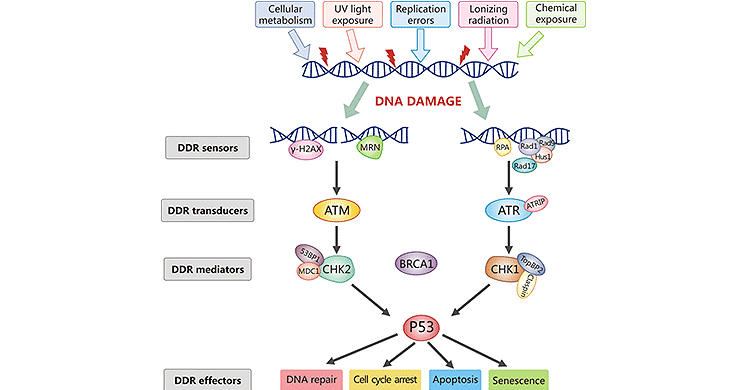
Cells inevitably sustain DNA lesions of varying types and severity. To maintain normal physiological functions and pass complete genetic information to offspring, cells have evolved a sophisticated and coordinated regulatory network known as the DNA damage response (DDR) to counteract genotoxic stress.
The DDR pathway plays a core role in maintaining genome integrity and stability. Sensor proteins first detect damaged DNA and activate downstream signal transducers such as ATM, ATR and Rad17-RFC complexes. These molecules further trigger DDR mediator proteins, including serine/threonine kinases Chk1, Chk2 and Cdc25 phosphatases. Activated mediators initiate multiple downstream effector mechanisms, including DNA repair, cell cycle checkpoint arrest, cell apoptosis or cellular senescence.
5.1 DNA Repair Mechanisms
Activation of DNA repair systems is the core output of the DNA damage response. Eukaryotic cells possess multiple distinct repair pathways to tackle different DNA lesions.
5.1.1 Excision Repair Systems
• Nucleotide Excision Repair (NER)
NER is the most versatile DNA repair pathway, capable of correcting DNA lesions induced by physical radiation and chemical carcinogens, including UV-derived products and large chemical adducts.
• Base Excision Repair (BER)
BER specializes in eliminating minor base modifications caused by oxidation, deamination and alkylation, which generally do not severely distort the DNA double helix.
5.1.2 Mismatch Repair (MMR)
The MMR system corrects base mismatches, base insertions and base deletions. It improves replication fidelity by over 100 times by fixing errors that escape the proofreading activity of replicative polymerases.
5.1.3 DNA Double-strand Break Repair (DSBR)
• Homologous Recombination (HR)
HR is a high-fidelity repair pathway that relies on intact homologous DNA sequences as repair templates, functioning mainly in S and G2 cell cycle phases.
• Non-homologous end-joining (NHEJ)
NHEJ is an error-prone pathway that serves as the main DSB repair mechanism in most mammalian cells, operating in G0, G1 and early S phases without requiring homologous templates.
5.2 Cell Cycle Arrest and Apoptosis
If DNA damage is fully repaired in a timely manner, cells will suffer almost no adverse effects. Unrepaired lesions may disrupt the expression of cell cycle-related proteins and trigger cell cycle arrest. When DNA damage is excessive, cells will stop energy-consuming repair processes and undergo apoptosis or enter a senescent state.
6. Link between DNA Damage and Human Diseases
Accurate DNA base sequences are the foundation for normal transcription and protein synthesis. DNA damage caused by internal metabolism and external hazards will lead to serious biological consequences. Unrepaired DNA lesions alter gene expression, inhibit cell division or induce cell death.
DNA damage is also a key driver of gene mutation and tumor formation. Research has confirmed that damage to both nuclear DNA and mitochondrial DNA is closely associated with the aging process.
DNA damage contributes to the occurrence and progression of many hereditary and degenerative diseases, such as xeroderma pigmentosum, ataxia-telangiectasia, Bloom syndrome and Werner syndrome. Persistent DNA lesions can promote cancer development when mutations occur in cell growth regulatory genes, and severe damage can lead to irreversible tissue injury and functional decline.