
ELISA Standard Reconstitution and Dilution
In Enzyme-Linked Immunosorbent Assay (ELISA), the standard curve is the core foundation for quantitative analysis of analytes, and its quality directly determines the reliability, accuracy, and reproducibility of experimental results. An ideal standard curve not only requires a good linear relationship but also needs to cover a dynamic detection range suitable for experimental needs to accurately reflect the true concentration of analytes in samples, providing strong support for scientific data interpretation and clinical detection judgments. The precise preparation of the standard curve relies first on the standardized handling of standards— reconstitution and gradient dilution. The operational standardization of these two links directly affects the accuracy of standard concentrations, thereby determining the quality of the entire standard curve, which is a key prerequisite for the success of ELISA experiments.
As the "benchmark reference" for quantitative calibration in ELISA experiments, the reconstitution effect of standard lyophilized powder and the concentration accuracy of gradient dilution are directly related to the linear fitting degree of subsequent standard curves and the credibility of detection results. Combined with the practical experience of ExKits ELISA kits, this article will detail the full-process specifications, key operational points, and precautions for standard reconstitution and gradient dilution, helping experimental personnel avoid operational mistakes, achieve precise standard handling, and lay the foundation for the preparation of high-quality standard curves.
I. Standard Reconstitution: Standardized Operation to Ensure Accurate Initial Concentration
1. Reagent Equilibration: Eliminate Temperature Difference Interference
After removing the ELISA kit from the 4℃ refrigerated environment, do not immediately open the standard lyophilized powder tube and standard dilution buffer. Allow both to equilibrate to room temperature. This can effectively avoid incomplete dissolution of lyophilized powder in a low-temperature environment and prevent concentration deviation caused by temperature difference after adding dilution buffer, ensuring the accuracy of the reconstituted stock solution concentration.
2. Brief Centrifugation: Ensure Complete Powder Sedimentation
Before opening the standard lyophilized powder tube cap, briefly centrifuge the lyophilized powder tube to achieve rapid powder sedimentation. Since standard lyophilized powder may adhere to the tube wall or cap due to bumping or vibration during transportation and storage, brief centrifugation can sediment all powder to the bottom of the tube, avoiding powder spillage after opening the cap, while ensuring that all lyophilized powder can fully contact and dissolve with the dilution buffer during subsequent liquid addition, ensuring no loss of initial concentration.
3. Liquid Addition and Resuspension: Precise Liquid Addition, Complete Dissolution
According to the kit instructions, accurately pipette 1mL of Standard & Sample Dilution Buffer, slowly add it to the standard lyophilized powder tube. When adding liquid, it can be slowly dripped along the tube wall to avoid splashing caused by impacting the powder. After liquid addition, tighten the tube cap, let it stand for 10 minutes to allow the lyophilized powder to fully hydrate, then invert gently several times. After the lyophilized powder is completely dissolved, mix gently. Avoid vigorous shaking to generate bubbles throughout the process. The concentration of the reconstituted stock solution is the highest concentration of the standard curve for this ELISA kit, also serving as the initial concentration for subsequent gradient dilution.
4. Key Precautions
During the reconstitution process, before the lyophilized powder is completely dissolved, do not use a pipette to vigorously blow and aspirate. Because undissolved protein powder is easily adsorbed by the pipette tip, and if vigorously blown and aspirated, some powder will adhere to the inner wall of the tip and be carried out, resulting in a reduction in the actual dissolved standard amount, ultimately leading to the stock solution concentration being lower than the theoretical value and affecting the accuracy of the subsequent standard curve. If the lyophilized powder dissolves slowly, the standing time can be appropriately extended, or gently inverted to mix, do not forcefully blow and aspirate.
II. Standard Gradient Dilution: Precise Speed Control, Ensure Uniform Gradient Concentrations
1. Preliminary Preparation: Equipment and Reagents Ready
Prepare 7 clean, impurity-free 1.5mL EP tubes, mark them sequentially with a marker pen, ensuring clear and non-confusing marks. Then, accurately add 500μL of Standard & Sample Dilution Buffer to each EP tube (the volume of dilution buffer can be flexibly adjusted according to actual experimental usage), preparing for subsequent gradient dilution.
2. Gradient Dilution Operation Specifications
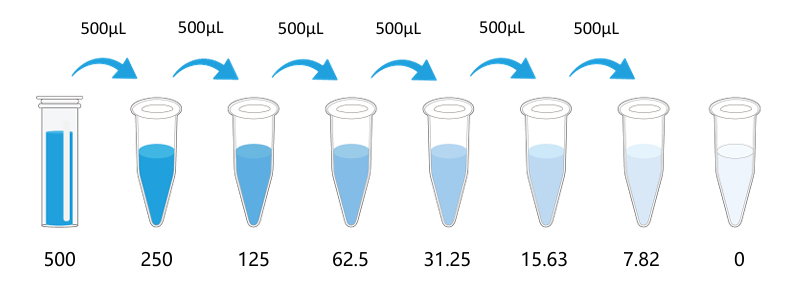
Taking ExKits Human TNF-α ELISA Kit as an example, the reconstituted standard stock solution concentration is 500pg/mL. The ELISA standard curve typically consists of 8 concentration points, 7 gradient concentrations + 1 standard dilution buffer blank control.
According to the experimental requirements, the standard is diluted in multiples. The recommended concentration gradient is: 500、250、125、62.5、31.25、15.63、7.82、0 pg/mL.
Multiple dilution method: Add 500μL of Reference Standard & Sample Diluent to each tube. Pipette 500μL of the 500pg/mL standard working solution and add it to the first EP tube. Mix it with a pipette to prepare a 250 pg/mL standard working solution. Next, take 500μL of the 250 pg/mL EP tube and add it to the second EP tube. Mix it with a pipette to prepare a 125 pg/mL standard working solution. And so on to obtain a standard working solution with multiple dilutions.
Note: The last tube is regarded as a blank. Just add the Reference Standard & Sample Diluent.
3. Key Precautions for Gradient Dilution
• Adequate mixing is core: After completing each gradient dilution operation, the pipette must be used to blow and aspirate 10 times, combined with vortex oscillation for 5 seconds, to ensure the standard and dilution buffer are fully mixed and the concentration is uniform before proceeding to the next dilution. This is a key step to ensure the accuracy of gradient concentrations. If mixing is insufficient, it will lead to gradient concentration deviation, thereby disrupting the linear relationship of the standard curve.
• Brief centrifugation aids precision: Before pipetting standard liquid from the previous concentration EP tube, the EP tube can be briefly centrifuged to centrifuge the liquid droplets adhering to the cap and tube wall to the bottom of the tube, ensuring the precise volume of liquid pipetted each time and avoiding gradient concentration deviation caused by residual liquid droplets.
• Clean equipment without interference: EP tubes and pipette tips used for gradient dilution must be clean, impurity-free, and free of cross-contamination. It is recommended to use disposable sterile tips and EP tubes to avoid residual contaminants affecting standard concentrations and prevent cross-interference between different concentration gradients.
III. Standardized Operation, Lay a Solid Foundation forELISA Experiments
Standard reconstitution and gradient dilution, although seemingly basic operations in ELISA experiments, directly determine the quality of the standard curve, thereby affecting the reliability of the entire experimental results. In scientific research experiments and clinical testing, many problems of poor standard curve linearity and distorted quantitative results originate from non-standard standard reconstitution and imprecise gradient dilution.
Following the reconstitution and dilution specifications described in this article, strictly controlling every operational detail, can effectively avoid problems such as concentration deviation and gradient distortion, prepare standard curves with good linearity and precise reliability, lay a solid foundation for the successful development of ELISA experiments, and help experimental personnel efficiently obtain high-quality experimental data.